
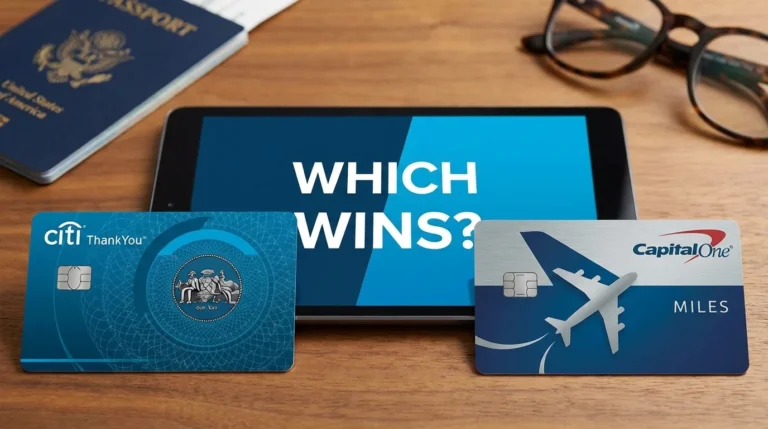
Most travelers treat credit card points like a generic currency. They assume a “mile” is a “mile.” This is the fastest way to lose thousands of dollars in value.
In 2025, the battle between Citi ThankYou Rewards and Capital One Miles isn’t just about which card looks cooler. It is a battle between two distinct philosophies: Maximum Potential vs. Maximum Efficiency.
I have spent the last decade dissecting loyalty program algorithms. I don’t care about shiny marketing brochures or “lifestyle” benefits. I care about the math. I care about Return on Spend (ROS).
If you are holding a Citi Strata Premier or a Capital One Venture X, you are sitting on a goldmine. But the pickaxes required to mine that gold are very different.
This guide compares these two ecosystems based purely on hard data, transfer ratios, and redemption mechanics effective as of December 2025.
The Core Philosophy: Math vs. Momentum
Before we look at the charts, you need to understand the “engine” driving these programs.
Citi ThankYou is a sniper’s tool. It requires patience. You need to hold the right combination of cards (the “Trifecta”), track spending caps on the Custom Cash, and navigate clunky websites. However, the payoff is the highest “ceiling” in the game. If you are willing to do the legwork, Citi points can arguably achieve higher cents-per-point (CPP) valuations than any other currency.
Capital One Miles is a blunt instrument. It relies on high-velocity earning. With a flat 2x earning rate on the Venture X, you don’t need to think. You just swipe. The “floor” value is higher because you can always redeem for travel purchases at 1.0 cent per point, something Citi struggles to match in simplicity. Capital One respects your time; Citi rewards your effort.
Transfer Partners: The Real Value Engine
If you are redeeming points for gift cards or Amazon purchases, stop reading and use our Points vs. Cash calculator to see why you are losing money. The only metric that matters here is Transfer Partners.
Both programs allow you to move points to airline and hotel loyalty programs. This is where a single point transforms from 1 cent into 5 or 10 cents of value. However, their rosters have distinct strengths.
The Shared “Backbone” Partners
Both Citi and Capital One transfer to these essential programs (usually at a 1:1 ratio):
- Avianca LifeMiles (Star Alliance): The king of mixed-cabin awards and no fuel surcharges.
- Flying Blue (Air France/KLM): The best way to get to Europe in Business Class.
- Turkish Airlines Miles&Smiles: Incredible sweet spots (like Hawaii for 7.5k miles), now accessible via both banks.
- British Airways/Avios (Oneworld): Capital One transfers directly; Citi transfers via Qatar Airways (which links 1:1 to British Airways).
- Virgin Red: Great for Delta One bookings or ANA First Class (if you can find space).
- Singapore Airlines KrisFlyer: The only way to book Singapore Suites or premium cabins long-haul.
Since both ecosystems share these, they effectively neutralize each other on standard bookings. The war is won in the exclusives.
Citi’s Exclusive Edge: The “High Ceiling”
Citi has two partners that act as force multipliers for your points balance.
1. Choice Privileges (1:2 Ratio)
This is the single most underrated redemption in the travel hacking world. Citi transfers to Choice at a 1:2 ratio. That means 1,000 Citi points become 2,000 Choice points.
The Math: High-end Choice hotels (Clarion Collection, Ascend Collection) in Scandinavia or Japan often cost 16,000 Choice points. With the 1:2 ratio, you only need 8,000 Citi points. If that hotel costs $300 cash, you are getting a staggering 3.75 cents per point. No other program offers this leverage on mid-tier hotels.
2. Leading Hotels of the World (LHW) & Better JetBlue Ratios
Citi is the only major transferable currency that partners with LHW (great for independent luxury hotels). Additionally, Citi transfers to JetBlue TrueBlue at 1:1, whereas Capital One often transfers at a lower ratio (typically 2:1.5 depending on the card), making Citi the better option for domestic Mint flights.
For a deeper dive on which partners offer the best returns, read our guide on Citi ThankYou Points: Best Transfer Partners.
Capital One’s Exclusive Edge: The “Safety Net”
Capital One’s exclusive list is shorter, but it fills specific niches that Citi cannot touch.
1. Air Canada Aeroplan
This is Capital One’s biggest advantage. Aeroplan is widely considered the most versatile Star Alliance program for booking partners like Swiss, Lufthansa, and ANA without high surcharges. Citi does not transfer to Aeroplan.
2. Accor Live Limitless (ALL)
Capital One transfers to Accor at 2:1. While not a “sweet spot” mathematically (Accor points have a fixed value of ~2.2 cents per point against hotel bills), it provides access to luxury brands like Fairmont and Sofitel.

Earning Rates: The “Trifecta” vs. The “Duo”
Valuing points is meaningless if you can’t earn them quickly. This is where the strategies diverge sharply. With the discontinuation of the Rewards+ 10% rebate in mid-2025, Citi’s earning dominance has narrowed significantly.
The Citi “Trifecta”: 2.9x Average Return
To maximize Citi, you still need to juggle multiple cards, though the “Quadfecta” is effectively dead. The optimal setup now involves:
- Citi Strata Premier: 3x on Dining, Gas, Supermarkets, Air Travel, Hotels.
- Citi Double Cash: 2x on everything else (1x when you buy, 1x when you pay).
- Citi Custom Cash (x2): 5x on your top category (up to $500/billing cycle). Many hackers hold two of these (via product change) to cover Groceries and Gas separately.
The Math: Without the 10% rebate boost, you are relying purely on the category multipliers. You still get the excellent 5x on Custom Cash categories, but your general spend is capped at a flat 2x. It remains a powerful setup, but it has lost the “magic math” that put it in a league of its own.
The Capital One Duo: The 2.5x Average
Capital One offers a streamlined approach that captures 90% of the value with 10% of the effort.
- Capital One Venture X: 2x on everything. Unlimited.
- Capital One SavorOne: 3x on Dining, Groceries, Entertainment, and Streaming.
That’s it. You use the SavorOne for food and fun, and the Venture X for literally everything else. You can combine the cash back from the SavorOne into Miles on the Venture X.
For a detailed breakdown of the food component, check our Capital One SavorOne Review. The beauty here is the “Floor.” You never earn less than 2x. With Citi, if you use the wrong card, you might earn 1x.
| Category | Annual Spend | Citi “Trifecta” Points | CapOne Duo Points |
|---|---|---|---|
| Dining | $5,000 | 15,000 (3x) | 15,000 (3x) |
| Groceries | $6,000 | 30,000 (5x Custom Cash) | 18,000 (3x) |
| Travel | $4,000 | 12,000 (3x) | 20,000 (5x Portal / 2x) |
| Misc/Bills | $15,000 | 30,000 (2x Double Cash) | 30,000 (2x Venture X) |
| TOTAL | $30,000 | 87,000 Points | 83,000 Miles |
Analysis: With the rebate gone, the gap has nearly vanished. The Citi setup earns only 4,000 more points per year in this scenario (~5% difference). This begs the question: Is managing three cards and monthly spending caps worth such a small margin over the “set and forget” Capital One duo?
Redemption Sweet Spots: The “Killer Apps”
Let’s look at a concrete example of how to use these points in 2025. We will focus on a complex redemption to show the “hacker” potential.
Scenario: Business Class to Europe
You want to fly from New York (JFK) to Frankfurt (FRA) in Business Class.
Using Capital One Miles:
You transfer 60,000 miles to Air Canada Aeroplan for a Lufthansa flight (no surcharges) or use Avianca LifeMiles.
- Cost: ~60k Miles + Low taxes.
- Process: Instant transfer, book online. Easy.
Using Citi ThankYou Points:
You could do the same LifeMiles transfer. BUT, here is the Citi twist: You could transfer to Choice Privileges.
Wait, for a flight? No. You use the points for the hotel in Europe.
If you transfer 30,000 Citi points to Choice (getting 60,000 Choice points), you can cover 3-4 nights at a solid hotel in central Frankfurt.
To get 3-4 nights via Capital One’s “Purchase Eraser,” you would need to burn roughly 60,000 to 80,000 miles (assuming a $150-$200 nightly rate).
The takeaway: Citi points stretch further on accommodation via the Choice partnership than Capital One miles do via the Eraser.
Ease of Use & The “Purchase Eraser”
We cannot ignore the friction factor. Not everyone wants to search for award availability at 2 AM.
Capital One wins this category by a landslide.
Their “Cover Travel Purchases” feature allows you to log in within 90 days of a travel purchase and “erase” the cost using miles at a rate of 1 cent per mile.
Did you book a boutique hotel that isn’t in a chain? Erase it.
Did you take a train in Italy? Erase it.
Did you pay airline taxes and fees? Erase them.
Citi allows you to “Shop with Points” or get cash back, but the rates often default to 0.5 or 0.8 cents per point unless you hold specific cards or link a checking account. It is opaque and often leads to accidental devaluation.
⚠️ Common Pitfall: The Portal Trap
Both banks push their “Travel Portals” aggressively, offering 5x or 10x points if you book through them.
My advice: Be careful.
Booking through a portal (Capital One Travel or Citi Travel) means you are booking via a third-party agency (often Hopper or Booking.com white-labels). If your flight is cancelled, the airline might refuse to help you directly.
Pro Tip: Use the portals for simple hotel bookings or car rentals to earn the multiplier, but transfer your points to partners for flights.
Verdict: Who Wins in 2025?
There is no “best” card, only the best card for you.
Choose Citi ThankYou if:
- You are willing to carry 3 credit cards to maximize earn rates.
- You travel to expensive cities (Scandinavia, Japan, NYC) where the Choice Privileges 1:2 ratio saves you fortune.
- You prioritize pure mathematical value over ease of use.
- Score: 9/10 for Value, 4/10 for Simplicity.
Choose Capital One Miles if:
- You want a “set and forget” wallet with just two cards.
- You need access to Air Canada Aeroplan (a huge gap in Citi’s portfolio).
- You want the flexibility to “erase” random travel expenses like trains and Airbnb.
- Score: 7/10 for Value, 10/10 for Simplicity.
For my wallet? I hold both. I use the Venture X as my catch-all for non-category spend (taxes, insurance) to build a floor of points, and I use the Citi Custom Cash to snipe 5x on groceries. In the travel hacking game, redundancy is not a bug—it’s a feature.
Frequently Asked Questions
Can I combine Citi ThankYou points with Capital One Miles?
Directly? No. You cannot transfer points from Citi to Capital One. However, you can combine them indirectly by transferring both to a shared airline partner. For example, if you need 100,000 miles for a ticket on Avianca LifeMiles, you can transfer 50k from Citi and 50k from Capital One into the same LifeMiles account.
Does Citi transfer to United or Delta?
No. Citi does not transfer directly to United or Delta. However, you can book United flights by transferring Citi points to Star Alliance partners like Avianca LifeMiles, Turkish Airlines, or Singapore Airlines. You can book Delta flights by transferring to Virgin Atlantic or Flying Blue.