

What Is a Credit Card Retention Offer?
A credit card retention offer is a targeted incentive—usually bonus points, statement credits, or an annual fee waiver—given by a bank to a customer who intends to close their account. These offers exist because of a metric called Customer Acquisition Cost (CAC). Banks spend between $500 and $1,500 in marketing and sign-up bonuses to acquire a single premium cardholder. It is mathematically cheaper for them to give you $200 to stay than to spend $1,000 finding your replacement.
For savvy travelers, retention offers are the single most effective way to reduce the cost of luxury credit cards. In 2026, we are seeing offers ranging from 20,000 to 100,000 points simply for asking the right question at the right time.
The Math: Why Banks Pay You to Stay
Before you pick up the phone, understand your leverage. Banks use complex algorithms to determine your “profitability score.” They analyze your swipe fees (interchange), interest paid, and likelihood of renewal. If their model predicts you are a profitable customer, the agent’s screen will populate with a retention offer.
However, if you simply cancel without asking, you leave this money on the table. A user with a Chase Sapphire Reserve might pay a $795 annual fee, but if they receive a $150 retention statement credit, their effective cost drops to $400. If they receive 35,000 points (valued at ~$700), the bank is effectively paying them to keep the card.
Step 1: Timing Your “Cancel” Call
Timing is critical. If you call too early, the system may not have generated an offer yet. If you call too late, you can’t get your annual fee refunded.
The Golden Window: 1 to 28 Days AFTER the Fee Posts.
Most issuers (Amex, Chase, Citi, Capital One) have a policy where they will fully refund your annual fee if you cancel within 30 days of it appearing on your statement. Calling during this window signals that you are serious about the cost because you are looking at the charge right now.
Pro Tip: Do not pay the annual fee before calling. Let it sit on your statement. This adds psychological weight to your negotiation script: “I see this $895 charge on my statement today, and I’m not sure I can justify it.”
Step 2: The Script (What to Say)
The biggest mistake people make is saying “I want to cancel” immediately. Some automated voice systems (IVR) will process a cancellation instantly without sending you to a human. You want to trigger a transfer to the Retention Department (sometimes called “Loyalty” or “Account Services”).
The Phone Script
Agent: “Thank you for calling. How can I help you?”
You: “Hi. I’m looking at my statement and the annual fee just posted. I’ve really enjoyed the card, but I’m not sure I’m getting enough value this year to justify the cost. I’m considering closing the account, but before I make a final decision, I wanted to check if there were any retention offers available to help offset the fee?”
Why this works:
- You used the “soft” threat: “Considering closing.”
- You gave a specific reason: “Value vs. Cost.”
- You asked a direct question: “Are there any offers available?”
The Chat Script (Amex & Citi)
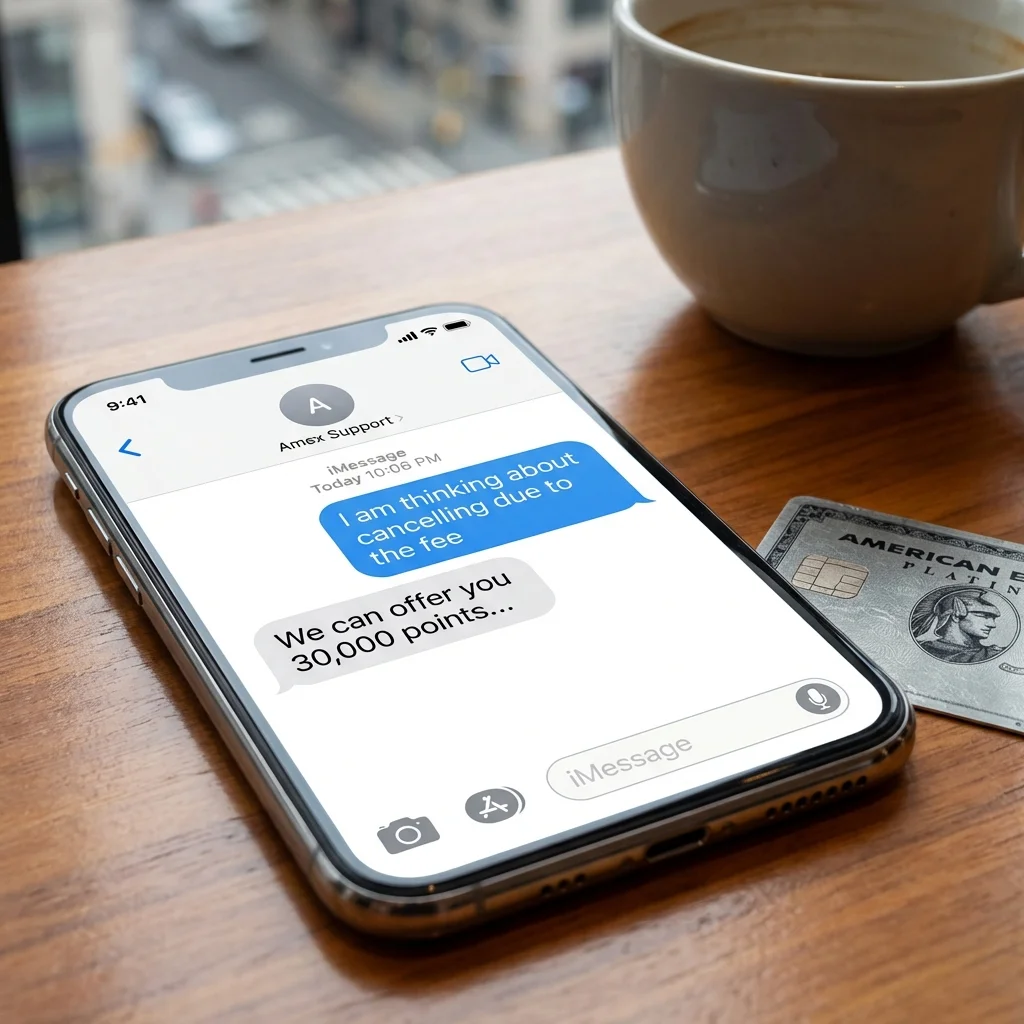
For 2026, American Express and Citi allow retention negotiations via their app or website chat. This is often faster and less awkward than a phone call.
You: “Hi, my annual fee just posted. I am evaluating whether to keep the card or cancel it. Can you check my account to see if I am eligible for any retention offers?”
Step 3: Bank-By-Bank Strategy (2026 Update)
Different banks behave differently. Here is the current “state of play” for retention offers as of January 2026.
American Express
Amex is the most generous issuer for retention offers, but they are also the most tech-forward. You can handle 90% of this via Chat.
- Typical Offer (Platinum): 20,000–50,000 points after spending $3,000–$4,000 in 3 months.
- Typical Offer (Gold): 15,000–30,000 points after spending $2,000 in 3 months.
- The Trap: Agents will often offer to let you “Pay your annual fee with points” at a special rate of 1.0 cent per point. Decline this. We value Amex points at ~2.0 cents. Using them at 1.0 cent cuts their value in half.
- Frequency: You can typically get one offer every 13 months. If you accept an offer, you MUST keep the card open for another 12 months, or they will claw back the points.
Chase
Chase is tougher. Their agents often have no power to override the system—the computer either shows an offer or it doesn’t. You must call; secure message generally does not work for retention.
- Typical Offer: Statement credits of $50, $100, or $150. Rarely points.
- Strategy: Be polite but firm. If the front-line agent says no, ask to be transferred to the “Account Specialists” department.
- Downgrade Path: If you get no offer on a Sapphire Reserve, consider downgrading to the Freedom Flex or Unlimited to preserve your credit history and points.
Capital One
Historically, Capital One offered almost nothing. However, since late 2024, we are finally seeing movement.
- Venture X Breakthrough: Targeted data points confirm Capital One is offering a $100–$200 travel credit to select Venture X holders who threaten to cancel, usually requiring minimal spend (e.g., $2,000 in 3 months). Note: This is highly algorithm-dependent.
- Method: You must call. Their chat agents usually cannot access retention offers.
Citi
Citi is the “wild card.” Their offers can be incredibly lucrative or non-existent, and they change weekly.
- Typical Offer (Strata Premier): “Spend $1,000–$3,000 in 3 months, earn 10,000 bonus points” or a “$95 statement credit.”
- Unique Quirk: Citi agents sometimes offer retention deals before you even mention cancelling, just for saying you are “unhappy with the fee.”
Step 4: The Math—Keep vs. Cancel?
Once you get an offer, how do you decide if it’s good? You need to run a “Net Cost” calculation. Let’s look at a real-world example for an Amex Platinum card in 2026.
| Item | Value | Notes |
|---|---|---|
| Annual Fee | -$895 | Standard fee posted to account |
| Retention Offer | +40,000 Points | Offer received for spending $3k |
| Value of Offer | +$800 | Valued at 2.0 cents per point |
| Uber/Airline Credits | +$400 | Conservative value of perks |
| NET VALUE | +$305 | Profit to keep the card |
In this scenario, accepting the offer makes the card profitable by $505. Even if you value the points conservatively at 1.0 cent ($400), you have wiped out the annual fee entirely.
Use our Points vs. Cash Calculator to determine the exact value of the points offered to you.
⚠️ Warning: The “Clawback” Risk
If you accept a retention offer, you are entering a contract. Most banks (especially Amex) require you to keep the card open for 12 months from the date you accept the offer. If you cancel or downgrade the card 11 months later, they will forcibly remove the points from your account (and if you have zero points, they may charge you the cash equivalent). Set a calendar reminder for 13 months out.
If You Strike Out: Downgrade or Cancel?
Sometimes the bank calls your bluff and offers nothing. Now you have a choice. If the card is one of your oldest accounts, closing it could hurt your credit score by lowering your average age of accounts. In this case, downgrading is the superior move.
- Chase: Downgrade Sapphire Reserve ($795) → Freedom Unlimited ($0).
- Amex: Downgrade Platinum ($895) → Gold ($325) or Green ($150). Note: Amex charge cards have no $0 downgrade path to credit cards (like the Blue Cash Everyday), which is why getting a retention offer is so vital.
- Citi: Downgrade Strata Premier ($95) → Double Cash ($0).
If you do decide to cancel, ensure you have a plan for your points. Learn more in our guide: Do Airline Miles Expire?.
Common Questions About Retention Offers
Does asking for a retention offer hurt my credit score?
No. Asking for a retention offer triggers a customer service inquiry, not a credit inquiry. There is no “hard pull” on your credit report for requesting or accepting a retention offer. Learn more about hard vs. soft inquiries here.
How often can I get a retention offer on the same card?
General wisdom suggests once every 13 months (specifically for American Express). However, Citi and Chase have been known to offer back-to-back retention offers in consecutive years if your spending on the card is high enough.
Can I get a retention offer if I haven’t used the card much?
Yes, but it is less likely. Banks prioritize “profitable” customers who swipe the card often. However, sometimes banks offer retention deals simply to keep their total subscriber numbers up for quarterly earnings reports, so it is always worth asking regardless of your spend.
What if I already paid the annual fee?
If it has been less than 30 days since the fee posted, you are fine; it will be refunded. If it has been months, you can still ask for an offer (like bonus points for spend), but you have lost the leverage of threatening to cancel for a full refund. The bank knows you are locked in for the rest of the year.