

Imagine you are hiking in Patagonia or diving in the Maldives when a serious injury occurs. The local clinic stabilizes you, but you need surgery that only a major trauma center can provide. The cost of a private air ambulance to fly you home? $50,000 to $200,000, payable upfront.
Most travelers assume their premium credit card “has insurance.” But when it comes to medical evacuation, the difference between “coverage” and “repatriation” can cost you your life savings. In 2026, the rules have tightened, and relying on the wrong card could leave you stranded in a foreign hospital.
Medical Evacuation vs. Medical Repatriation:
Medical Evacuation is the emergency transport from the place of injury to the nearest adequate facility (e.g., from a jungle clinic to a city hospital).
Medical Repatriation is the transport from that facility back to your home country or hospital of choice.
Critical Distinctions: Most credit cards cover Evacuation to the nearest hospital. Very few cover Repatriation back home unless it is deemed “medically necessary” by their doctor, not yours.
The Top Contenders: Who Covers What?
Not all “premium” cards are equal. In 2026, the landscape is dominated by three major players, but their policies differ radically in how they handle a crisis.

1. The American Express Platinum Card®
The Benefit: Premium Global Assist (PGA) Hotline.
The Limit: No stated financial cap (uncapped).
The Catch: Absolute control.
The Amex Platinum is unique. Unlike other cards that act as “insurance” with a dollar limit, Amex acts as a service provider. If you get hurt while traveling more than 100 miles from home, they will coordinate and pay for the evacuation completely, provided their medical team agrees it is necessary.
The upside is that you don’t have to worry about a $100,000 bill exceeding a cap, and you do not have to pay for the trip with the card to access this specific medical transport benefit. The downside is that Amex decides where you go. If you are in Vietnam and need surgery, and Amex determines the hospital in Ho Chi Minh City is “adequate,” that is where you go. You cannot demand to be flown to Los Angeles.
2. Chase Sapphire Reserve®
The Benefit: Emergency Evacuation and Transportation.
The Limit: $100,000.
The Trigger: Must charge a portion of the trip to the card.
The Chase Sapphire Reserve (CSR) offers a more traditional insurance policy with a $100,000 limit. Crucially: Unlike Amex, you must charge the full cost of your common carrier travel (flight, train, cruise) to the card or use Chase points for the benefit to apply.
Warning: The Chase Sapphire Preferred does not have medical evacuation coverage. It only covers trip cancellation and interruption. Do not confuse the two.
3. Capital One Venture X
The Benefit: Emergency Evacuation and Transportation.
The Limit: $100,000.
The Trigger: Must pay for the trip with the card.
Similar to Chase, the Capital One Venture X provides a $100,000 safety net as part of its Visa Infinite® benefits. The key distinction is the “common carrier” requirement. To activate this coverage, you typically need to have charged your flight or common carrier fare to the card. It offers solid protection, but the trigger is stricter than Amex’s.
| Feature | Amex Platinum | Chase Sapphire Reserve | Capital One Venture X |
|---|---|---|---|
| Coverage Limit | Uncapped (Service based) | $100,000 | $100,000 |
| Trigger Requirement | Cardmembership + 100+ miles from home | Pay portion of trip | Pay for trip |
| Repatriation Goal | Nearest Adequate Facility | Nearest Adequate Facility | Nearest Adequate Facility |
| Who Arranges It? | MUST be Amex | MUST be Benefit Admin | MUST be Benefit Admin |
| Family Coverage | Spouse + Dependents under 22 (26 if student) | Spouse + Dependents under 19 (26 if student) | Spouse + Dependent Children |
The “Nearest Adequate Facility” Trap
This is the single most misunderstood aspect of travel insurance. “Evacuation” does not mean “going home.”
If you break your leg in rural Italy, the “nearest adequate facility” is likely a local Italian hospital, not your orthopedic surgeon in Chicago. As long as the local hospital meets western medical standards, the credit card’s obligation ends there. They are not required to fly you home just because you would prefer to recover in your own bed.
Real-World Example: A traveler suffers a stroke in Tokyo. Tokyo has world-class hospitals. The credit card insurance will likely deny a request to fly the patient back to New York because the care in Tokyo is deemed “adequate.” The patient is then stuck in Japan until they are well enough to fly commercially.
When Credit Cards Are Not Enough
For many travelers, especially those crossing oceans, the $100,000 limit and the “nearest hospital” rule are deal-breakers. This is where third-party membership programs fill the gap.
The “Hospital of Choice” Solution
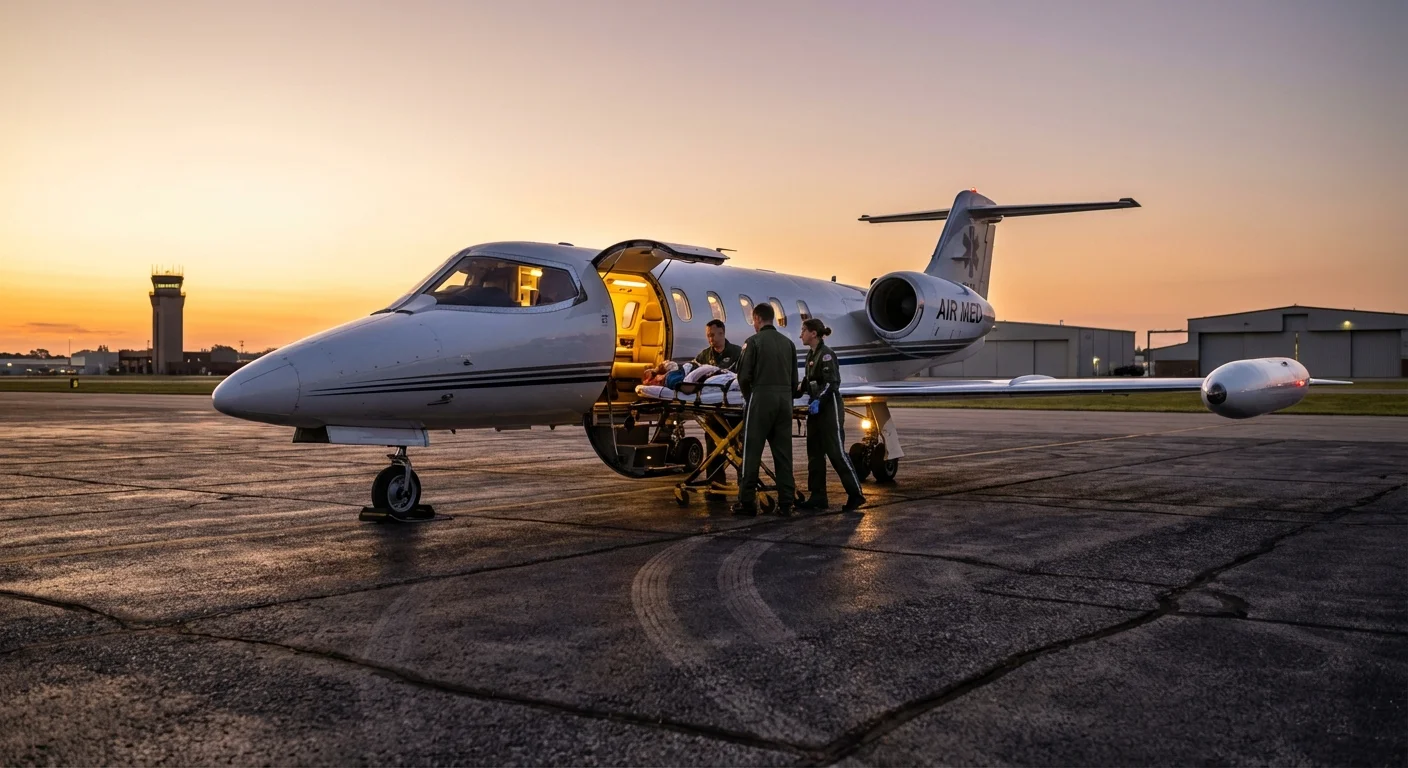
Services like Medjet and Global Rescue operate differently. They are memberships, not insurance. Their primary value proposition is “Hospital of Choice” transfer.
If you are hospitalized 150+ miles from home, Medjet will send a jet to pick you up and fly you to the hospital of your choice at home, regardless of whether the local hospital is “adequate.” There are no claim forms, no deductibles, and no monetary caps on the flight cost.
- Cost: Approx. $315/year for an individual (MedjetAssist).
- Value: If you need a long-haul evac (e.g., South Africa to USA), the flight could cost $180,000. Medjet covers it fully; a Chase card would cap at $100,000, leaving you with an $80,000 bill.
For more on protecting your trips, check our guide to the Top 5 Credit Cards with Best Travel Insurance in 2026.
How to Actually Use the Benefit (Don’t Mess This Up)
If you find yourself in an emergency, following the correct protocol is the difference between a free flight and bankruptcy. Here is the step-by-step process:
1. Call Before You Move
You strictly cannot arrange your own transport. Do not let the local hospital call a private ambulance company. You or a family member must call the number on the back of your credit card (or the benefits administrator number provided in your guide) immediately.
2. Get Medical Authorization
The benefits administrator will open a case. They will contact the local attending physician to get a medical report. They will not approve a flight until their own medical team agrees that evacuation is medically necessary.
3. Paperwork is Key
Keep every receipt, medical report, and discharge paper. Even with Amex’s “service” model, you need documentation to prove the timeline of events. If you are using a card like the Venture X, you may need to prove you paid for the trip with that card.
Conclusion: Is Your Card Enough?
For domestic travel or trips to major developed nations (UK, France, Japan), a premium card like the Chase Sapphire Reserve or Amex Platinum is likely sufficient. The local care is good, and a short-range evac falls within the $100,000 limit.
However, if you are trekking in Nepal, diving in remote Indonesia, or cruising in Antarctica, relying solely on a credit card is a financial gamble. In these scenarios, the cost of evacuation exceeds card limits, and the definition of “adequate facility” becomes risky. Supplement your card with a dedicated medical transport membership to ensure you always get back home.
Frequently Asked Questions
Does the Chase Sapphire Preferred cover medical evacuation?
No. The Chase Sapphire Preferred covers trip cancellation and interruption, but it does not include the $100,000 emergency medical evacuation benefit found on the Reserve card. This is a common misconception.
Does health insurance cover medical evacuation?
Rarely. Most US domestic health insurance plans (including Medicare) provide zero coverage for medical evacuation outside the 50 states. Some premium PPO plans may reimburse emergency care, but they almost never pay for a $100,000 private medical jet.
What counts as an “immediate family member”?
For Chase, “Immediate Family” is broad and can include your spouse, children, and even parents or siblings traveling with you. Capital One is stricter, generally limiting coverage to the Cardholder, Spouse (or Domestic Partner), and dependent children.
Do I have to pay for the flight with my card to get coverage?
For the Amex Platinum, no—the medical evacuation benefit is available to Card Members traveling more than 100 miles from home, regardless of how the trip was paid for. For Chase and Capital One, yes—you typically must charge a portion (Chase) or the entirety (Capital One) of the common carrier fare to the card to activate the insurance.




1 comment
If you book with “miles” and pay the tax with a Venture X, is that good enough for coverage?