

You have 80,000 points sitting in your account. You see a flight for $600, or you can book it for 60,000 miles. Do you burn the stash or pay the cash?
Most travelers get this wrong. They view points as “free money” and spend them indiscriminately on $200 domestic hops. This is the fastest way to destroy 50% of your portfolio’s value.
As a travel hacker, I don’t see points as vacation coupons; I see them as a currency that fluctuates against the dollar. Your goal is to treat your loyalty account like a forex trader treats a currency pair. You only “sell” (redeem) when the exchange rate is in your favor.
In this guide, I will give you the exact Points vs. Cash Calculator I use for every booking in 2025, supported by the math that separates the rookies from the pros.
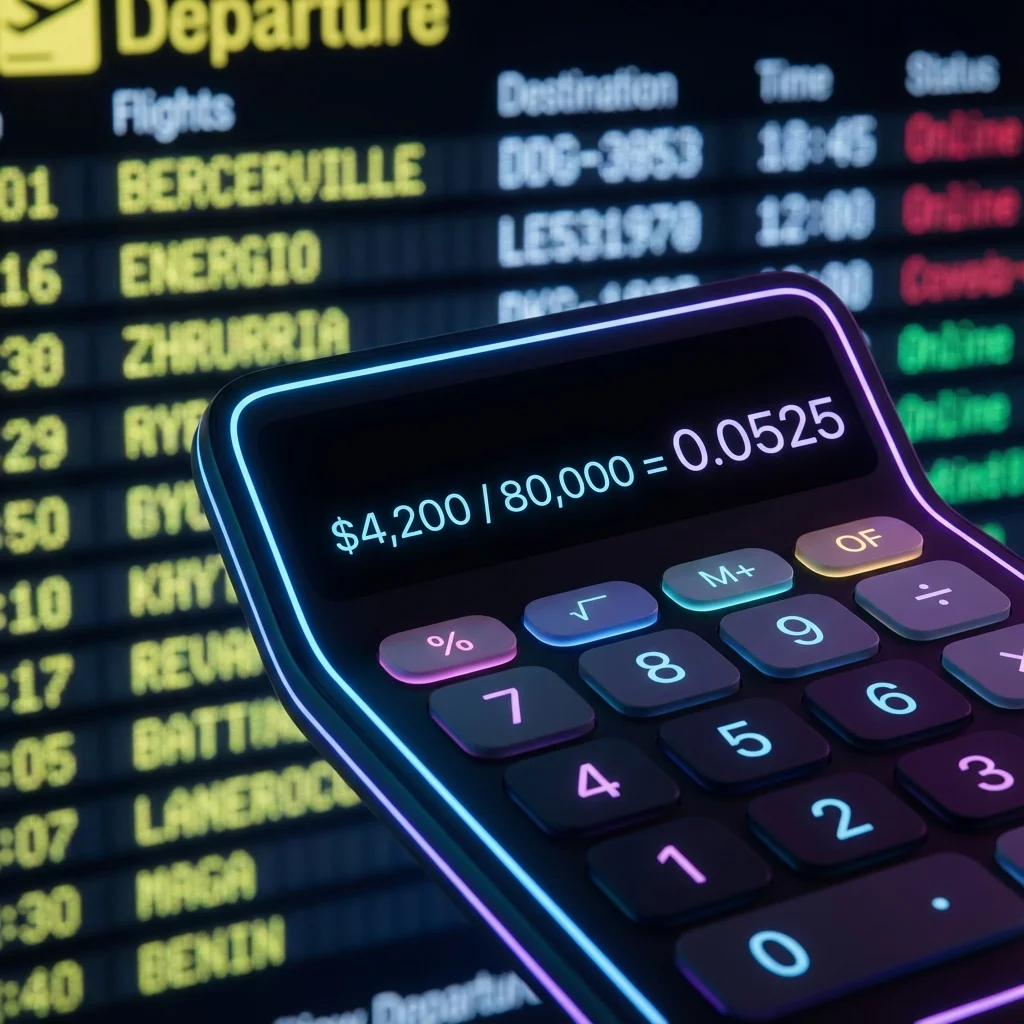
The Math: How to Calculate “Cents Per Point” (CPP)
Before you book anything, you must know your CPP (Cents Per Point). This is the single most important metric in travel hacking. It tells you exactly how much value you are extracting from each point.
The formula is simple, but you must include the taxes to be accurate. You can run these numbers instantly using our free Points vs. Cash Calculator tool.
The Formula
(Cash Price of Ticket – Taxes You Must Pay on Award) ÷ Points Required = Value Per Point
Multiply the result by 100 to get the Cents Per Point (CPP).
Example A: The Bad Redemption
- Flight: New York (JFK) to Miami (MIA) in Economy.
- Cash Price: $250.
- Award Cost: 25,000 Delta SkyMiles + $6 taxes.
- The Math: ($250 – $6) / 25,000 = 0.0097.
- Result: 0.97 cents per point.
Verdict: PAY CASH. Travel points explained simply: 0.97 cents is terrible value. You are effectively burning points for less than a penny each.
Example B: The Winner
- Flight: Chicago (ORD) to Munich (MUC) in Lufthansa Business Class.
- Cash Price: $4,200.
- Award Cost: 80,000 LifeMiles + $50 taxes.
- The Math: ($4,200 – $50) / 80,000 = 0.0518.
- Result: 5.18 cents per point.
Verdict: USE POINTS. You are getting 5x the value compared to the economy ticket. This is the “arbitrage” opportunity that makes this game worth playing.
The 2025 Hurdle Rate: What is a Point Worth?
To know if a redemption is “good,” you need a benchmark. This is called your “Hurdle Rate.” If the CPP calculation doesn’t jump over this hurdle, you pay cash.
As of December 18, 2025, here are the baseline valuations for the major currencies. These numbers reflect the reality of recent devaluations, including the changes to Singapore Airlines KrisFlyer and the new Atmos Rewards program.
| Currency | Hurdle Rate (Min Value) | Target Value (Aim For) |
|---|---|---|
| Chase Ultimate Rewards | 1.5¢ | 2.0¢+ |
| Amex Membership Rewards | 1.5¢ | 2.0¢+ |
| Capital One Miles | 1.4¢ | 1.8¢+ |
| Alaska Atmos Rewards | 1.4¢ | 1.8¢+ |
| United MileagePlus | 1.0¢ | 1.2¢ |
| Delta SkyMiles | 1.1¢ | 1.2¢ |
| Southwest / JetBlue | 1.3¢ | 1.4¢ |
Pro Tip: If you are transferring flexible points (Chase/Amex) to a partner, your hurdle rate is 1.7 cents. Why? Because you can cash out Chase points for 1.5 cents via the Sapphire Reserve portal, or invest Amex points for 1.1 cents (Schwab). Redeeming for less than 1.5 cents is mathematically losing money.
When to Pay Cash (The “Save” Strategy)
Even if you have millions of miles, there are times when paying cash is the superior strategic move. Here is when I keep the credit card out.
1. Domestic Economy Flights
In 2025, US airlines use dynamic pricing that ties the mileage cost to the cash price. United might charge 15k miles for a $150 flight (1.0 CPP). This is a wash. I prefer to pay cash here to earn miles on the flight and save my transferable points for high-value international partners.
2. Chasing Elite Status
If you are short on Premier Qualifying Points (PQP) or Loyalty Points, remember: Award tickets usually don’t count toward status spend. (Exceptions exist for Delta and United, but they earn at lower rates than cash tickets). If you need to hit a status tier by December 31st, pay cash.
3. “Deal” Fares & Error Fares
If you find a mistake fare to Europe for $400 round-trip, do not waste 60,000 points on it. That yields a CPP of roughly 0.6 cents. Pay cash, earn the miles for the distance flown, and keep your hard-earned points for a ticket that would actually cost $4,000.
⚠️ The Taxes Warning
Be careful with programs like British Airways or Emirates. They often tack on “carrier-imposed surcharges” that can reach $800+ per ticket. If an award costs 60,000 Avios + $850 taxes for a ticket that costs $1,200 cash, your real savings are only $350. That’s a CPP of 0.5 cents. Always check the fees.
When to Use Miles (The “Burn” Strategy)
This is where we unlock outsized value. These scenarios typically offer CPP values of 3.0 to 8.0 cents.
1. International Business & First Class
This is the holy grail. A one-way ticket in Qatar Airways Qsuite often retails for $5,000+ but can be booked for 70,000–80,000 points. The math is undeniable:
- Cash: $5,200
- Points: 75,000 Avios + $100 fees
- CPP: 6.8 cents per point
You cannot get this return with cash back. This is the only way most of us will ever fly in a $10,000 suite.
2. Last-Minute Flights
Airlines often jack up cash prices for flights departing in less than 7 days, but award prices on partners (like booking United via Air Canada Aeroplan or American via British Airways) often remain fixed. I’ve seen $800 walk-up fares for a 1-hour flight available for just 6,000 points. That is a CPP of over 10 cents.
3. One-Way Tickets
International cash tickets are notoriously expensive if booked one-way (often costing more than a round-trip). Award tickets generally cost exactly 50% of a round-trip. If you are building a complex itinerary—say, flying into London and out of Tokyo—using points for one-way segments saves you thousands compared to “open-jaw” cash fares.

Advanced Variable: The Opportunity Cost
There is a hidden cost to using points: Foregone Earnings.
When you pay cash for a flight, you earn miles (usually 5x to 11x per dollar depending on status/card). When you book with points, you earn zero. To be truly precise, you should add the value of the miles you would have earned to the cost of the award ticket.
However, unless you are spending $100k+ a year on flights, this is usually negligible for the average traveler. The simpler heuristic is: if you are low on points, lean toward cash. If you are flush with points (over 200k), lower your hurdle rate to 1.3 cents just to burn the liability.
Need to restock your balance? Check out our guide on how to earn 100k points fast without destroying your credit score.
Comparison: Real World Scenarios (Dec 2025)
Let’s look at three live examples using current data to see the calculator in action.
| Route | Cash Price | Points Cost | CPP Value | Decision |
|---|---|---|---|---|
| NYC to London (Economy) | $550 | 60,000 Delta (Round Trip) | 0.8¢ | Pay Cash |
| LA to Tokyo (Business) | $6,200 | 85,000 ANA (One Way) | 7.1¢ | Use Points |
| Miami to Dallas (Last Min) | $480 | 9,000 Avios (One Way) | 5.2¢ | Use Points |
| SFO to Hawaii (Economy) | $280 | 25,000 Atmos Rewards | 1.1¢ | Pay Cash |
Notice the “SFO to Hawaii” example using the new Alaska Atmos Rewards. Even though Atmos points are valuable, using 25k for a $280 flight is poor value (1.1 CPP). You should save those Atmos points for partner redemptions on JAL or Qatar.
Frequently Asked Questions
Does it ever make sense to buy points to book a flight?
Yes, but only if the math works. If you can buy points at 1.8 cents during a promotion (see our guide on buying points) and redeem them for a First Class ticket worth 6.0 cents, you are buying a discount. Never buy points speculatively; only buy them if you have a specific seat on hold.
Should I pay with “Cash + Points” options?
Rarely. Airlines often offer a rate of 0.8 to 1.0 cents per point when you use the “Cash + Points” slider at checkout. This is almost always a bad deal compared to a full award redemption or just paying cash. The only exception is if you have a tiny balance of orphan miles you will never use otherwise.
Do Amex transfer fees ruin the value?
Amex charges a small excise tax (0.06 cents per point) for transfers to US airlines like Delta. For a 50,000 point transfer, that is $30. While annoying, it doesn’t break the math on high-value redemptions. However, you can learn how to avoid these fees by transferring to foreign partners like Air Canada Aeroplan instead.
What is the best site to check cash prices?
I always start with Google Flights to see the calendar view of cash prices. For finding award availability, tools like PointsYeah or Seats.aero are essential in 2025. Always check the official airline site (e.g., United.com) to confirm “Saver” space exists before transferring any points.
Do miles expire if I don’t use them?
Policies vary by airline. In 2025, many major carriers like United and Delta do not expire miles, but others like Singapore Airlines have a strict 36-month “hard expiry.” Always check our 2026 Expiration Guide to ensure you don’t lose your stash while waiting for the perfect redemption.