
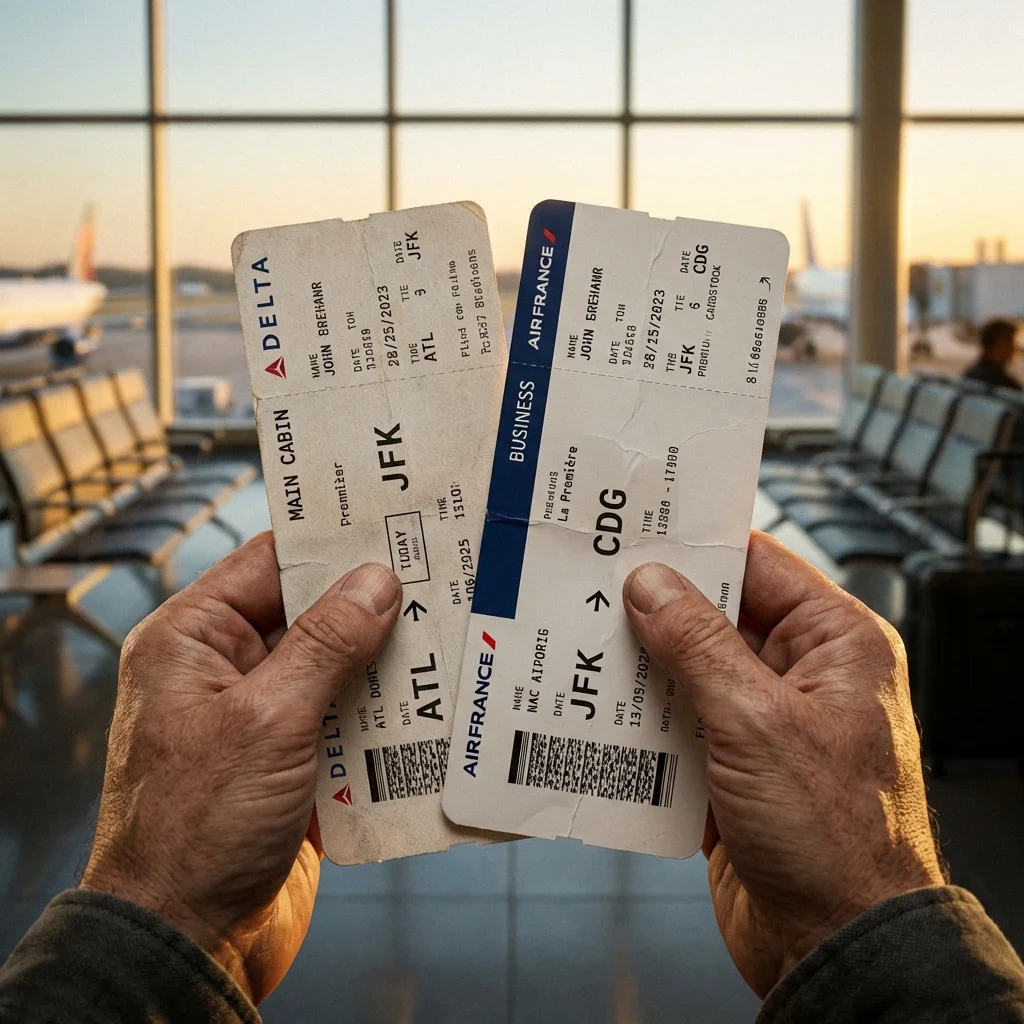
You have the points. You found the perfect Business Class seat to Paris on Air France. But there is one problem: the flight departs from New York (JFK), and you live in Columbus, Ohio. When you try to book the itinerary from Columbus to Paris, the price jumps from 50,000 points to 120,000 points—or worse, the availability disappears entirely.
This is the single most common frustration in award travel. The solution is the “Positioning Flight.”
By treating your itinerary as two separate problems—getting to the gateway, and then getting to your destination—you can unlock sweet spots that are invisible to travelers searching for simple point-to-point tickets. However, this strategy removes the safety net of a single itinerary. If you do it wrong, you could be stranded at JFK with a worthless ticket. If you do it right, you save thousands.
What Is a Positioning Flight?
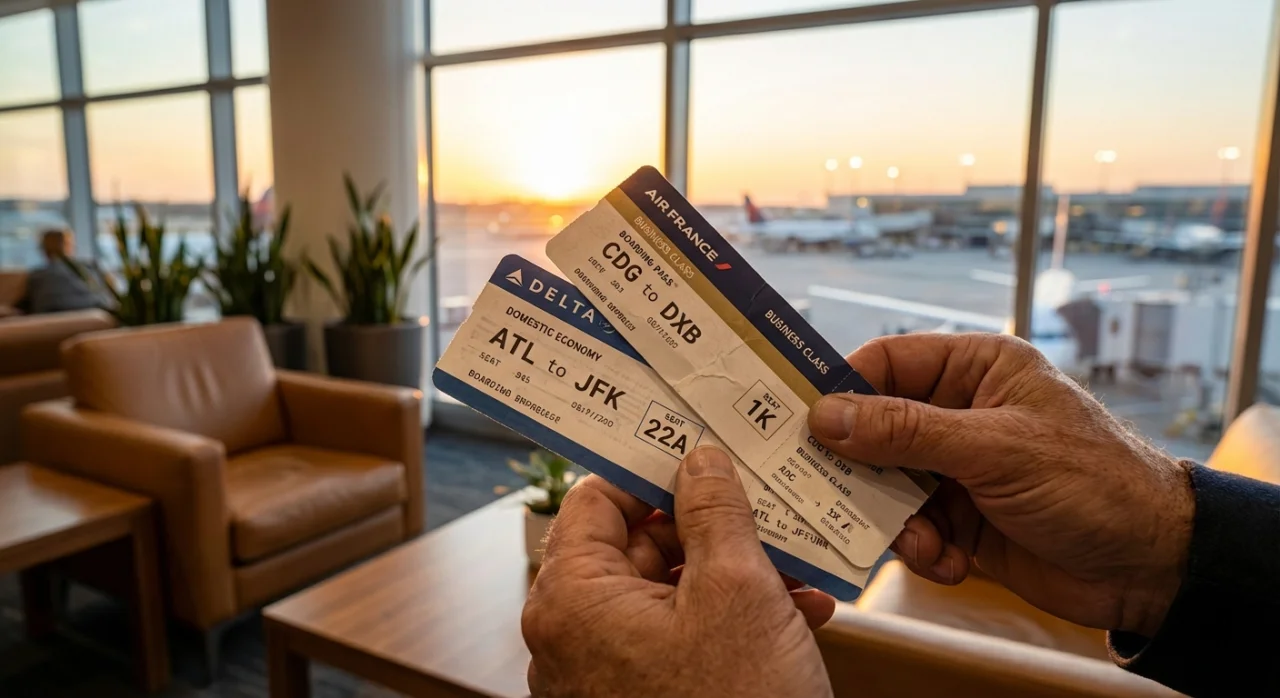
A positioning flight is a short-haul flight purchased on a separate ticket—using cash or points—to travel from your home airport to a major international gateway (hub) where a long-haul award flight is available. This strategy decouples the domestic leg from the international leg, allowing travelers to bypass “married segment” logic, avoid dynamic pricing surges at smaller airports, and access better inventory at major hubs like New York (JFK), Los Angeles (LAX), or Chicago (ORD).
The Math: Why Take the Risk?
Why would anyone risk booking separate tickets? Because the mathematical savings are undeniable. Airlines use sophisticated algorithms called “Married Segment Logic.” They might be willing to sell a seat from JFK to Paris for 50k points, but if you add a Columbus to JFK leg, they might block that same Paris seat because they want to sell the Columbus-Paris route for cash.
Let’s look at a real-world pricing scenario for a Business Class trip to Europe in mid-2026:
| Route Strategy | Itinerary | Ticket Cost | Taxes & Fees |
|---|---|---|---|
| Direct Search | Columbus (CMH) → Paris (CDG) via JFK | 125,000 Flying Blue Miles | $210 |
| Positioning | Columbus (CMH) → New York (LGA) [Cash Ticket] | $149 Cash (0 Points) | $0 (Included) |
| Long-Haul Award | New York (JFK) → Paris (CDG) | 50,000 Flying Blue Miles | $210 |
| TOTAL | CMH → JFK/LGA → CDG | 50,000 Points + $149 | $210 |
In this scenario, spending $149 cash to “position” yourself to New York saves you 75,000 miles. If you value Flying Blue miles at 1.2 cents each, those saved miles are worth roughly $900. Even after subtracting the $149 positioning flight, you come out $751 ahead in value.
This is frequently necessary when booking Flying Blue Promo Rewards, which often target specific gateway cities like Boston or Miami but ignore the rest of the country.
Step-by-Step: How to execute a Positioning Strategy
You cannot simply book two flights and hope for the best. You need a rigorous process to ensure you don’t get stranded.
1. Reverse Search Your Route
Stop searching from your home airport. Instead, identify the major hubs that fly to your destination. Use a tool like FlightConnections to visualize which US airports have direct flights to your target.
- Going to Europe? Search out of JFK, EWR, IAD, BOS, ORD.
- Going to Asia? Search out of LAX, SFO, SEA, YVR.
- Going to South America? Search out of MIA, IAH, ATL.
2. Secure the Long-Haul Award First
Book the “hard” flight first. Find that Saver level Business Class seat on Qatar Airways, ANA, or Air France. Once that is confirmed, you have locked in the core value of your trip.
3. Find Your Positioning Flight
Now, look for a one-way domestic flight to get to that gateway. Do not limit yourself to the same alliance. If you are flying United to Tokyo, it is perfectly fine to fly Southwest or Delta to get to San Francisco.
Pro Tip: This is one of the best uses for British Airways Avios. Because Avios charges by distance, short hops on American Airlines or Alaska Airlines (e.g., Charlotte to JFK) can often be booked for around 13,000 to 16,000 points. While this has increased in recent years (it used to be under 10k), it still provides flexibility and cancellation protection that a Basic Economy cash ticket does not offer.
The “Gotcha”: Airport Co-Terminals
Be extremely careful with cities that have multiple airports. New York has JFK, LaGuardia (LGA), and Newark (EWR). Domestic positioning flights often land at LGA, but international flights usually depart from JFK.
Transferring from LGA to JFK can take 60 to 90 minutes in traffic. Never book a connection that requires an airport change unless you have a 6+ hour layover.
The 4 Golden Rules of Risk Management
When you fly on separate tickets, you are taking full responsibility for the connection. If your first flight is delayed due to weather and you miss the second flight, the second airline will mark you as a “No Show.” They will cancel your ticket and likely void your return journey as well. Here is how to protect yourself.
Rule #1: The 4-Hour Buffer
Never schedule a connection shorter than 4 hours. Even 4 hours is aggressive for winter travel. Domestic flights are routinely delayed by 1-2 hours. If you have a 4-hour buffer, a 2-hour delay is stressful but manageable. If you have a 2-hour buffer, a 30-minute delay can ruin your trip.
For high-stakes trips (e.g., a honeymoon or a Once-in-a-Lifetime First Class redemption), fly in the night before. The cost of an airport hotel is your insurance policy.
Rule #2: Do Not Check Bags (If Possible)
Airlines on separate tickets generally will not “interline” bags (transfer them automatically). You usually have to:
- Land at the gateway hub.
- Exit the secure area to baggage claim.
- Pick up your bag.
- Walk to the international terminal.
- Re-check your bag with the new airline (adhering to their check-in cutoff times, usually 60 minutes).
- Go back through TSA security.
This process takes time. Having TSA PreCheck or Global Entry is essential here to speed up the re-screening process.
Rule #3: Use Flexible Points for the Short Hop
Booking the positioning flight with cash is risky if your long-haul flight changes. If Lufthansa changes your departure from 5 PM to 1 PM, your non-refundable cash ticket on United might be useless. By using points (like Southwest Rapid Rewards or Avios), you can often cancel and rebook instantly with minimal fees.
Rule #4: Know Your Insurance Limits
Many travelers assume their credit card travel insurance covers this. Most do not. Standard “Trip Delay” insurance usually kicks in only for delays of 6-12 hours caused by covered hazards (weather, equipment failure). It rarely covers “I booked a tight connection on separate tickets and missed it.”
However, some premium cards offer more robust protections if the delay is significant. Check our guide on the top cards for travel insurance to see which policies might offer a safety net, but never rely on them as your primary plan.
Advanced Strategy: The “Partner Shield”
There is one exception to the separate ticket danger: booking different airlines that are partners on a single ticket. For example, if you book United (domestic) and Lufthansa (international) on the same reservation number (PNR), you are protected. If United is late, Lufthansa must rebook you.
However, this returns to the original problem: finding award availability for both legs at once is hard. The “Partner Shield” is great when it works, but Positioning Flights are for when it doesn’t.
Real-World Sweet Spots for Positioning
Here are three reliable scenarios where positioning flights consistently beat single-ticket bookings in 2026:
- Virgin Atlantic to London: Virgin Atlantic often releases massive amounts of award space from Boston (BOS) and Washington (IAD) to London. The taxes/fees are high, but the availability is reliable. It is often easier to position to BOS than to find a Delta One seat from your home airport. Check our Virgin Atlantic Guide for the latest on surcharges.
- Singapore Airlines to Asia: Singapore Airlines rarely releases long-haul Business Class space to partners. You almost always have to book via KrisFlyer out of gateways like LAX, SFO, or JFK. You generally must position to fly them.
- Iberia to Madrid: One of the most famous sweet spots is JFK/BOS/IAD to Madrid for roughly 40,500 Avios in Business Class (off-peak). This rate is rarely available if you try to add a connection from the Midwest, and be aware that Chicago (ORD) has moved to a higher pricing band (Band 6).
Conclusion
Positioning flights are the tool that separates expert travel hackers from casual points collectors. By accepting a small amount of logistical friction—and managing it with long layovers and airport hotels—you gain access to the world’s best flight products at the lowest possible rates.
Don’t let the fear of a connection stop you. Just remember the mantra: Buffer time is cheaper than a new business class ticket.
Frequently Asked Questions
Will airlines transfer my bags on separate tickets?
Generally, no. Most airlines (even within the same alliance, like United and Lufthansa) now refuse to “interline” bags on separate tickets. You must assume you will need to claim your bags and re-check them. There are rare exceptions (sometimes full-service carriers will do it if you show both tickets at the counter), but never bank on it.
What is the minimum connection time for positioning flights?
The absolute minimum recommended is 4 hours. This accounts for a potential 1-hour arrival delay, 45 minutes to claim bags, 20 minutes to transfer terminals, and 60 minutes for the check-in cutoff of the international flight. If you are changing airports (e.g., LGA to JFK), allow at least 6 to 8 hours.
Does travel insurance cover missed connections on separate tickets?
Rarely. Most “Trip Interruption” policies exclude missed connections resulting from separate tickets unless the delay was substantial (often 12+ hours) or caused by very specific reasons like severe weather. “Tight scheduling” is never a covered reason. Always read your policy’s fine print regarding “Common Carrier” delays.
Can I use the lounge during my positioning layover?
Yes, provided you have a boarding pass for the departing flight and lounge access via status or a credit card. Note that if you arrive domestically and your next flight is in a different international terminal, you won’t be able to access the international lounges until you re-clear security in that terminal. Check LoungeBuddy for access rules.



1 comment
This goes both ways. Sometime taking a connecting flight (or skiplagging) results in a cheaper flight. All depends on airline, region, sales, … aka who really knows :)