

Most travelers leave 50% to 70% of their potential rewards on the table. They focus entirely on the credit card swipe—earning 1x or 2x points per dollar—while ignoring the massive multipliers available through a simple browser click.
The math is undeniable. If you spend $200 at Nike.com using just a credit card, you might earn 400 points. By using a “Triple Stack” strategy, that same purchase can yield 2,000+ points and $50 in cash back, all for the same $200 spend. This isn’t about spending more; it’s about optimizing the transaction flow you are already executing.
This guide breaks down the exact mechanics of the Triple Stack, the best portals to use in 2026, and the mathematical proof of why this strategy is the fastest way to earn airline status without flying.
What Is the “Triple Stack” Strategy?
The “Triple Stack” is a methodology where you layer three independent reward sources onto a single transaction. Because these systems rarely communicate with each other in a way that blocks rewards, they stack perfectly.
The Equation:
(Credit Card Rewards) + (Portal Bonus) + (Store Discount/Card Offer) = Total Return
Real-World Example: Buying a $200 Jacket
Let’s look at the math for a hypothetical purchase at Saks Fifth Avenue using the Triple Stack method versus a standard checkout.
| Method | Action | Result |
|---|---|---|
| Standard | Direct checkout with debit card | $0 Rewards |
| Triple Stack | Layer 1: Use Amex Platinum (via Rakuten setting) | 200 Amex Points (1x spend) |
| Layer 2: Click via Rakuten (10x Promo) | 2,000 Amex Points | |
| Layer 3: Amex Platinum Saks Credit | $50 Statement Credit | |
| TOTAL | Spend: $150 (after credit) | 2,200 Points + $50 Saved |

In this scenario, you saved $50 cash and earned 2,200 points (valued at ~$44). The “return on spend” jumps from 0% to nearly 63% (based on net cost).
The Mechanics: How Shopping Portals Work
Shopping portals are affiliate marketing sites. When you click a link on Rakuten, United MileagePlus Shopping, or AAdvantage eShopping, a tracking cookie is placed on your browser. This cookie tells the retailer (e.g., Nike, Sephora, Home Depot) that the portal sent you.
The retailer pays the portal a commission (e.g., 5% of your purchase). The portal then splits that commission with you in the form of cash back, airline miles, or credit card points.
Key Technical Rules for 2026
- The Cookie Must “Win”: If you click a portal link, then open a new tab to search for a coupon code, you might overwrite the portal’s tracking cookie with a coupon site’s cookie. Always click the portal link last.
- Ad Blockers Kill Rewards: Extensions like AdBlock or uBlock Origin often block the tracking pixel required to verify your purchase. You must whitelist the portal or use a clean browser profile (e.g., a separate Chrome Profile for “Shopping”).
- Apps Break Tracking: If you click a link on your phone and it forces the retailer’s app to open, tracking often fails. Stick to desktop browsers for high-value purchases to ensure the “handshake” between portal and retailer is recorded.
Best Shopping Portals for 2026
Not all portals are created equal. Some offer cash, others offer transferable points, and some offer elite status credits. Here are the three you need to know.
1. Rakuten (The King of Transferable Points)
Rakuten (formerly Ebates) is unique because it allows you to earn American Express Membership Rewards points instead of cash back. This is arguably the most valuable currency in the game.
- Earning Rate: 1% Cash Back = 1 Membership Rewards Point.
- Why It Wins: If Rakuten offers “15% Cash Back” at a store, you earn 15x Amex points per dollar. Since we value Amex points at ~2.0 cents each, that is effectively a 30% return on your spend.
- Pro Tip: Wait for major holidays (President’s Day, Memorial Day, Black Friday) when rates often spike to 15x–20x.
2. AAdvantage eShopping (The Status Maker)
Unlike other airline programs, American Airlines counts shopping portal earnings toward Loyalty Points. This means you can earn top-tier Executive Platinum status without ever setting foot on a plane.
- Math: 1 Base Mile Earned = 1 Loyalty Point.
- Strategy: If you find a store offering 10 miles per dollar, spending $1,000 earns you 10,000 Loyalty Points. This is crucial in 2026, as Basic Economy tickets no longer earn status credits.
- Important Distinction: While “Base Miles” count as Loyalty Points, “Bonus Miles” (e.g., “Spend $200, get 500 extra miles”) typically do not count toward status. Focus on the per-dollar earn rate for status chasing.
3. United MileagePlus Shopping
United miles do not count toward Premier Qualifying Points (PQP) directly, but the earn rates can be aggressive. This is often the best portal for topping off an account for a specific redemption.
- Current Promo: As of January 18, 2026, United is offering a “New Year Bonus” where spending $150 earns 500 bonus miles. These small wins add up.
- Exclusives: United often has exclusive high rates for Apple products and delivery services like Viator.
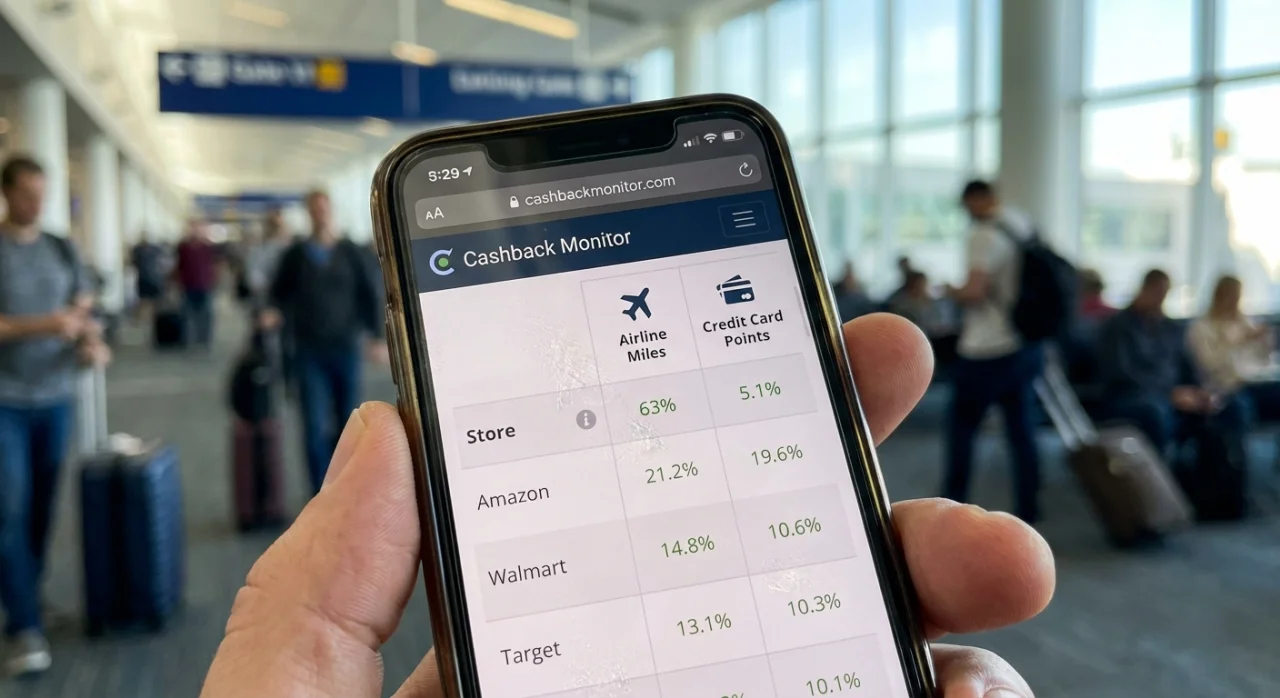
How to Choose: The “Cashback Monitor” Method
Never guess which portal to use. The payouts fluctuate daily. A store might offer 2x points on United today but 8x on Rakuten tomorrow.
Use Cashback Monitor. This aggregator tracks payout rates across every major portal.
The 30-Second Search Workflow:
- Go to Cashback Monitor.
- Type in the store name (e.g., “Home Depot”).
- View the “Best Rate History” column. If the current rate is 2x but the history shows it frequently hits 10x, wait if your purchase isn’t urgent.
- Compare “Credit Card Points” (Rakuten/Amex) vs. “Airline Miles.”
Decision Logic: If I need AA Loyalty Points for status, I choose AAdvantage eShopping even if the rate is slightly lower. If I want maximum value for business class flights, I choose Rakuten for Amex points. To understand the relative value of these points, check our Points vs. Cash Calculator.
Advanced Strategy: Stacking with Card-Linked Offers
The “Fourth Layer” of the stack is the card-linked offer. Chase, Amex, Bank of America, and Citi all have “Offers” portals where you must manually activate deals.
The Golden Rule of Stacking: These offers operate on the billing statement level. The shopping portal has no idea you are using them. This means they always stack.
Example Scenario: You see an Amex Offer for “Spend $100 at Lululemon, get $20 back.”
1. Activate the offer on your Amex card.
2. Go to Cashback Monitor -> Find Rakuten offering 10x points at Lululemon.
3. Click through Rakuten.
4. Checkout at Lululemon.com for $100 using that specific Amex card.
Result: You pay $100. You get $20 back from Amex (Net cost: $80). You earn 1,000 Amex points from Rakuten (10x). You earn 100 Amex points from the card swipe (1x).
Common Mistakes & “Gotchas”
1. Buying Gift Cards
Many retailers explicitly exclude gift card purchases from earning portal rewards. Check the “Terms & Conditions” on the portal page before buying. If the terms say “Excludes Gift Cards,” you will receive 0 points.
2. Using External Coupon Codes
If you use a promo code found on a site like RetailMeNot that isn’t listed on the shopping portal, the retailer may deny the commission to the portal. Only use coupon codes provided inside the portal or unique codes sent to you directly (like a birthday code), though even unique codes carry a risk.
3. Returns Claw Back Points
If you return an item, the retailer revokes the commission. The portal will then deduct the points from your account. If you have already transferred those points to an airline, your portal account may go into the negative, absorbing future earnings until the debt is paid.
Conclusion: The ROI of Effort
The Triple Stack strategy adds approximately 60 seconds to your checkout process. In exchange, you can earn returns of 10% to 30% on everyday spending. For a family spending $20,000 a year on online retail (clothes, electronics, home improvement), this strategy alone can generate 80,000+ points annually—enough for a one-way business class ticket to Europe.
If you are looking to maximize these points for family trips, see our guide on Family Travel Points Strategy to see how far 80k points can take you.
Frequently Asked Questions
Do shopping portals cost money to use?
No, shopping portals are completely free. They make money by earning a commission from the retailer when you make a purchase, which they then share with you. You pay the exact same price for the product as you would going directly to the website.
Can I use a shopping portal for Amazon purchases?
Yes, but it is limited. Portals like JetBlue or certain cashback sites sometimes offer rewards for specific Amazon categories (e.g., Amazon Devices or Luggage), but rarely for the entire site. Always check the category exclusions carefully.
How long does it take for points to post to my account?
Typically, the purchase “tracks” within 24 to 48 hours, showing up as “Pending” in your portal account. The points usually become “Payable” or transfer to your airline/hotel account after the retailer’s return period closes, which is often 30 to 60 days. AA Loyalty Points, however, often post within a few days of the transaction date.
Do I lose my points if I return the item?
Yes. If you return an item, the retailer reverses the commission paid to the portal, and the portal will deduct the corresponding points from your balance. If your balance is zero, your account will show a negative balance that must be earned back with future purchases.