
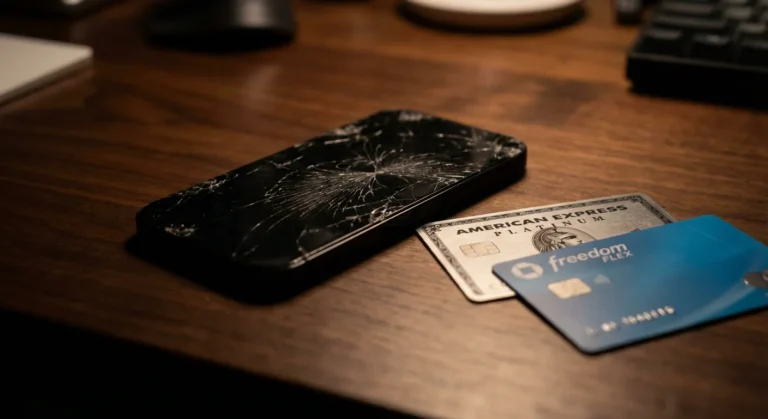
You are likely throwing away $200 a year. If you are paying Verizon, AT&T, or T-Mobile $15 to $18 a month for device insurance, you are buying a product you probably already own for free.
Most travelers know about trip delay insurance or rental car waivers, but the most mathematically valuable benefit on your premium credit card is often the one you use every day: Cell Phone Protection.
Is it real? Yes. Is it easy to use? That depends on your ability to follow instructions. As someone who treats credit card benefits like a software system to be optimized, I have filed these claims myself. The insurers don’t make it intuitive, but they do pay out—if you have the right documentation.
In this guide, we will break down the exact math of why you should cancel your carrier insurance, which cards offer the best coverage in 2026, and the specific step-by-step workflow to ensure your claim gets approved.
The Math: Why Carrier Insurance is a Bad Deal
Let’s look at the numbers. In 2026, a standard carrier insurance plan (like Verizon Mobile Protect or AT&T Protect Advantage) costs approximately $17 per month per device. That is $204 per year just for the privilege of having coverage.
On top of that premium, if you crack your screen, you still pay a deductible. While screen repair deductibles have dropped (often $0–$29), full device replacement deductibles for a flagship phone like the iPhone 16 Pro can still hit $200+.
Compare that to the Credit Card Strategy:
- Monthly Premium: $0 (Included with card).
- Deductible: $25–$50 (depending on the card).
- Coverage Limit: Usually $800 (enough to cover almost any repair and most of a replacement).
The Calculation:
If you break your phone once in two years:
Carrier Route: ($17 x 24 months) + $29 deductible = $437 cost.
Credit Card Route: $0 premiums + $50 deductible = $50 cost.
You are saving nearly $400 every two years simply by switching which piece of plastic pays your T-Mobile bill. This is one of the first steps I recommend in my New Credit Card Setup Guide.
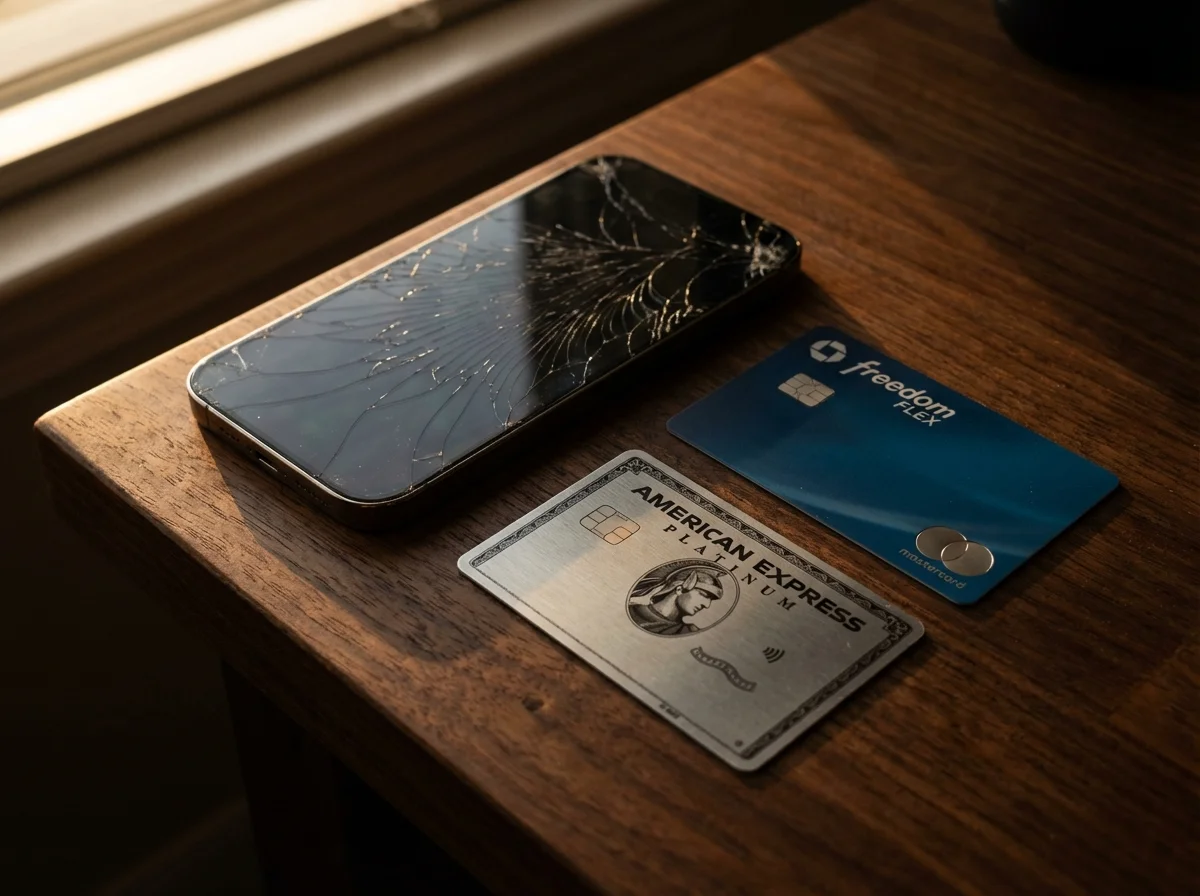
The Best Credit Cards for Phone Protection (2026)
Not all policies are created equal. While many cards have dropped this benefit, the heavy hitters in the travel space have kept it. Here are the top contenders based on coverage limits and low deductibles.
| Card | Coverage Per Claim | Deductible | Annual Fee |
|---|---|---|---|
| Bilt Mastercard® | $800 | $25 | $0 |
| Chase Freedom Flex® | $800 | $50 | $0 |
| Amex Platinum Card® | $800 | $50 | $695 |
| Capital One Venture X | $800 | $50 | $395 |
| Wells Fargo Active Cash® | $600 | $25 | $0 |
1. Bilt Mastercard® (Best Deductible)
The Bilt card is unique because it carries no annual fee yet offers “World Elite Mastercard” protections. The $25 deductible is the lowest in the industry. If your repair costs $300, Bilt reimburses you $275. It covers theft and damage, but be careful with “loss”—mysterious disappearance is rarely covered.
2. Chase Freedom Flex® (Best No-Fee Backup)
Many people ignore this card for insurance because it’s marketed as a cash-back card, but it packs an $800 per claim limit. Since it earns 5% back on rotating categories, you do have to weigh the opportunity cost. Does paying your phone bill earn 1x points (1%) or 5x? Even at 1x, the insurance savings usually outweigh the points you’d earn on a different card.
3. The Platinum Card® from American Express
If you are already paying the $695 annual fee, you should be maximizing every perk. Amex’s coverage is robust ($800/claim) and their claims processor (AIG) is generally professional. However, remember the Amex vs. Chase ecosystem debate: Amex only earns 1x points on phone bills, whereas a card like the Chase Ink Business Preferred might earn 3x (though Ink has a $100 deductible).
The “Pre-Paid” Trap
Be very careful if you use Mint Mobile, Visible, or Cricket Wireless. The terms and conditions usually require a “monthly billing statement.” If you pay for a full year of Mint Mobile upfront to get a discount, coverage may not apply because you are not making a monthly payment in the billing cycle prior to the damage. Always read the fine print for “pay-as-you-go” exclusions.
Step-by-Step: How to File a Successful Claim
Insurance companies are designed to deny claims that lack proof. As a travel hacker, your job is to provide undeniable documentation. I have successfully filed claims with both Card Benefit Services (Chase/Bilt) and AIG (Amex). Here is the winning workflow.
Step 1: The “Paper Trail” Setup
Before anything breaks, ensure your autopay is set. The terms invariably state the coverage applies “if you paid the previous month’s bill with the eligible card.” If you switch cards halfway through the month, you might have a coverage gap.
Step 2: Get a Diagnostic Quote Immediately
If your screen cracks, do not just get it fixed. Go to the Apple Store or an authorized repair shop and ask for a written diagnostic quote. The insurance adjuster needs a document that says “Repair Estimate: $329” before they approve the payout. If it is a theft, you MUST file a police report within 48 hours. No police report = automatic denial.
Step 3: Submit the “Big 3” Documents
When you log into the claims portal (usually mycardbenefits.com or americanexpress.com/onlineclaim), upload these three things immediately to avoid delays:
- Proof of Payment: Your credit card statement showing the charge for the cell phone bill in the month prior to the incident.
- The Phone Bill Itself: The actual PDF from Verizon/T-Mobile. It must list the specific device IMEI or phone number that was damaged. If your kid’s phone broke, but your bill doesn’t list their line clearly, you will have issues.
- The Incident Proof: The repair estimate (for damage) or the police report (for theft).
For more on managing documentation and financial optimization, check out our guide on Points vs. Cash calculations—the mindset of tracking value applies here too.
Common “Gotchas” and Exclusions
Is it perfect? No. Here is where they get you.
1. “Mysterious Disappearance”
If you leave your phone in an Uber and can’t find it, that is “loss,” not “theft.” Most credit card policies exclude loss. To be covered, it usually must be stolen (with a police report) or damaged. If you are prone to losing phones, stick with AppleCare+ with Theft & Loss.
2. Cosmetic Damage
If your casing is scratched but the phone works perfectly, the claim will be denied. The damage must impact the “functionality” of the device. However, a cracked screen is almost always considered functional damage because it poses a safety risk (glass shards).
3. Taxes are rarely covered
If the replacement phone costs $800 plus $60 tax, the insurance often only reimburses the base price up to the limit. Be prepared to eat the tax difference.
The Verdict: Is It Real?
Cell phone protection from credit cards is 100% real, and for the disciplined user, it is a massive money saver. It requires you to be organized—you must keep your bills and be ready to upload PDFs—but the savings of $200+ per year are tax-free money in your pocket.
If you are still paying for carrier insurance in 2026, cancel it today. Switch your autopay to a card like the Bilt Mastercard or Chase Freedom Flex, and use those savings to fund your next trip.
Frequently Asked Questions
Does credit card cell phone protection cover lost phones?
Generally, no. Most policies (including Chase and Bilt) specifically exclude “mysterious disappearance.” The phone must be stolen (verified by a police report) or damaged. If you frequently lose your device, you should purchase AppleCare+ with Theft and Loss or carrier insurance.
Can I claim coverage for a phone I bought years ago?
Yes. Unlike “Purchase Protection” which only covers new items for 120 days, Cell Phone Protection covers whatever phone is currently linked to the monthly bill you pay with the card. You could have an iPhone 13 from 2022; as long as you pay the current month’s service bill with the eligible card, it is covered.
Does it cover everyone on my family plan?
Usually, yes. The terms typically state coverage applies to “lines listed on your monthly billing statement.” If you pay a Family Plan bill with 4 lines using your Chase Freedom Flex, all 4 devices are generally eligible for coverage, subject to the annual claim limits (usually 2 claims per 12 months).
Is credit card cell phone insurance primary or secondary?
It is almost always secondary. This means if you have other insurance (like renters insurance or carrier insurance), you must file with them first. However, if you have no other insurance, the credit card benefit becomes your primary coverage and pays the full eligible amount.