
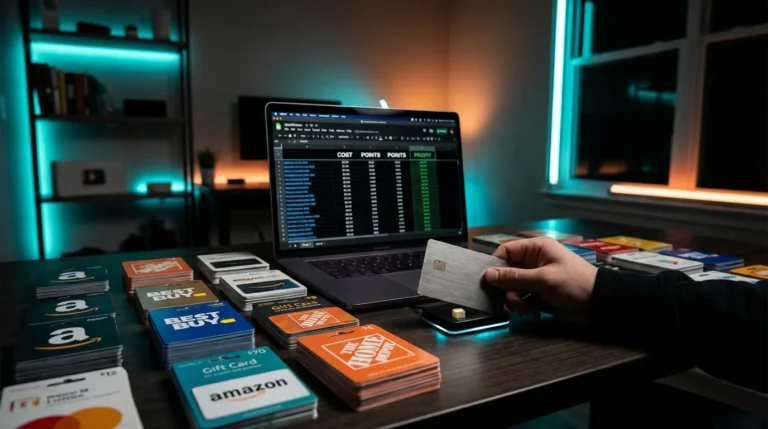
There is a specific thrill in walking out of a grocery store with $2,000 in gift cards and a receipt showing 8,000 newly minted points. It feels like you’ve hacked the system. You are printing your own currency. But in 2025, that thrill often comes with a side of dread.
Gift card reselling—buying cards to earn credit card rewards and then selling them to recoup the cash—has long been the “dark art” of travel hacking. It is mathematically beautiful but operationally terrifying. While the payoff is theoretical “free” First Class flights, the reality involves floating thousands of dollars, dodging fraud departments, and risking a permanent ban from the banks you love.
I have treated loyalty programs like an arbitrage market for over a decade. I have seen the Golden Age of the “Redbird” and the mass shutdowns of 2024 and 2025. This article isn’t a cheerleader’s guide to easy points; it is a risk assessment for those asking if the game is still worth playing.
What Is Gift Card Reselling?
At its core, gift card reselling is a form of Manufactured Spending (MS). The goal is to generate credit card spend without actually “spending” money. You purchase a cash-equivalent asset (a gift card) using a high-earning credit card, then liquidate that asset back into cash.
The cycle typically looks like this:
- Buy: You purchase a $500 gift card (e.g., Amazon, Best Buy, or Visa) at a grocery store or office supply store.
- Earn: You use a card that earns a multiplier, such as 4x points on groceries or 5x on office supplies.
- Sell: You sell the card to a “Buying Group” or a public exchange (like CardCash or Raise).
- Repeat: You take the cash, pay off your credit card, and pocket the points.
In a perfect world, you break even on the cash and keep the points for free. In the real world, you deal with transaction fees, shipping costs, and the constant threat of theft.

The Math: Why We Do It (The “Free” Travel Myth)
We take these risks because the math is intoxicating. When you treat points acquisition as a business, you look at your Cost Per Mile (CPM). If you can buy a point for less than you can redeem it, you have a profitable arbitrage opportunity.
Let’s break down a typical 2025 scenario using a 4x grocery multiplier:
| Variable | Value |
|---|---|
| Gift Card Purchase Price | $500.00 |
| Activation Fee | $0.00 (Merchant Cards) or $5.95 (Visa GC) |
| Points Earned (4x on $500) | 2,000 Points |
| Resale Payout (98% Rate) | $490.00 |
| Net Cash Loss | -$10.00 |
| Cost Per Point Calculation | $10.00 / 2,000 Points |
| Final Cost Per Point (CPM) | 0.50 Cents |
In this scenario, you are effectively “buying” 2,000 points for $10. If you redeem those points for a Business Class flight worth 4.0 cents per point, you have realized an 800% Return on Investment (ROI).
This math is why veterans ignore the effort required for status and focus purely on point acquisition. However, this spreadsheet victory assumes nothing goes wrong. And in 2025, things often go wrong.
The Risks: Why You Might Lose Everything
If the math is so good, why isn’t everyone doing it? Because the “cost” isn’t just the $10 loss. It includes the risk of financial ruin, account shutdowns, and legal gray areas. Before you buy your first stack of cards, you need to understand the four pillars of risk.
1. The “Shut Down” (Amex RAT & Chase Security)
Banks are not stupid. They have entire departments dedicated to identifying “non-organic” spending. In 2025, American Express’s Rewards Abuse Team (RAT) is more aggressive than ever. They look for Level 3 Data (which shows exactly what you bought) and round-number transactions at grocery stores.
If you are cycling $15,000 a month at supermarkets, you will eventually trigger a manual review. The consequence isn’t just a polite warning; it is a total relationship termination. You lose all your points, all your cards, and you are blacklisted for years. For a detailed comparison of how these banks operate, read our guide on Amex vs. Chase ecosystems.
2. The Financial Float Trap
When you sell to a Buying Group, you are not paid instantly. You scan the cards, submit the numbers, and wait. The wait can be 3 days or 3 weeks. During that time, you still have to pay your credit card bill.
If a Buying Group delays payment or—worst case—goes bankrupt (like The Plastic Merchant did years ago), you are left with a massive credit card bill and zero cash. If you are floating $20,000 worth of inventory and the buyer disappears, that is a $20,000 personal debt you must cover immediately.
3. Retailer Bans
It’s not just the banks that hate this. Retailers like Amazon, Walmart, and Best Buy employ sophisticated fraud detection. If you constantly redeem high-volume gift cards or buy them in bulk, they will lock your account. Losing your primary Amazon account in 2025 is a massive lifestyle inconvenience that often requires hours of phone calls to resolve, if it can be resolved at all.
4. Theft and “Tampered” Cards
The most visceral risk happens in the store. Organized crime rings have mastered the art of “tampering.” They steal physical cards from the rack, scan the magnetic stripe or record the numbers, and return them to the shelf. When you load $500 onto that card, their bot instantly drains the balance before you even leave the store.
According to the Federal Trade Commission (FTC), gift card draining scams cost consumers hundreds of millions annually. If this happens to you, the store will likely refuse a refund, and the credit card issuer may deny a chargeback because “you participated in the transaction.”
Buying Groups vs. Public Exchanges
If you are determined to proceed, you have two primary avenues for liquidation. Choosing the right one determines your risk profile.
Buying Groups (The “Wholesale” Model)
Buying Groups (e.g., The Card Bay, Aligned Incentives) act as private clubs. They tell you exactly what to buy (e.g., “We need $10,000 in Home Depot cards”) and offer a set payout rate, often close to 97-100%.
- Pros: You can move volume quickly. They often accept “bulk” submission.
- Cons: High counterparty risk. If the group is a Ponzi scheme or runs out of cash, you are the bag holder.
Public Exchanges (The “Retail” Model)
Sites like Raise or CardCash allow you to list cards for sale to the general public.
- Pros: Legitimate companies with some seller protections.
- Cons: High fees (15%+ commission) destroy your margins. You also face “chargeback” risk if a buyer claims the card didn’t work 30 days later.
Methodology: How to Mitigate the Danger
If you are going to ignore the warnings, you must act professionally. Chaos is the enemy of Manufactured Spending. Here is the strict protocol I use when testing these methods:
- Never Float Money You Don’t Have: If you cannot pay off the credit card bill today from your checking account, do not buy the gift card. Never rely on the resale payout to pay the bill.
- Start Small: Do not buy $5,000 in your first week. Start with a single $100 card to test the end-to-end process with a specific buyer.
- Diversify Your Spend: Do not just buy gift cards. Mix in organic spending. If your grocery bill is exactly $505.95 every single day, you are flagging yourself.
- Check for Tampering: Before buying a physical card, run your finger over the barcode and PIN cover. If it feels uneven, bulky, or scratched, put it back. Better yet, buy digital codes (e-gift cards) whenever possible to avoid physical theft.
- Keep Receipts Forever: I photograph every receipt and every card back immediately. You will need these if a card is blocked or stolen.
For those looking for safer ways to hit minimum spend requirements without this level of risk, I highly recommend reading our guide on earning 100k points without churning.
Is It Worth It? The Final Verdict
In 2025, for the vast majority of people, the answer is No.
The margins have tightened, and the banks have gotten smarter. The stress of managing thousands of dollars in float, coupled with the real risk of a hard credit shutdown, outweighs the benefits of earning an extra 10,000 points a month.
There are easier ways to earn points. You can pay your taxes (even with the fee) for a guaranteed, safe transaction. You can focus on sign-up bonuses. You can utilize shopping portals. These methods are scalable and safe. Gift card reselling is manual, dangerous, and fragile.
However, if you are mathematically obsessed and have a high risk tolerance, it remains one of the few ways to generate points at scale for near-zero cost. Just remember: in this game, you are not the customer. You are the loophole. And loopholes eventually close.
For more on managing your financial setup safely, check out our mathematically optimal beginner credit card setup.
Frequently Asked Questions (FAQ)
Is selling gift cards illegal?
No, selling gift cards you legally purchased is not illegal in the United States. However, it often violates the Terms and Conditions of the retailer (like Amazon or Walmart) and your credit card issuer. While you won’t go to jail, you can be banned from stores and banks permanently.
Which credit cards are best for buying gift cards?
Travel hackers typically use cards with high multipliers on groceries or office supply stores. For example, a card earning 4x on groceries turns a $500 gift card purchase into 2,000 points. However, these are also the cards most monitored by banks for abuse.
What is the safest way to liquidate a gift card?
The safest way is to use the gift card for your own organic spending (e.g., buying a Home Depot card because you actually plan to renovate your kitchen). Reselling to a third party always introduces the risk of non-payment or fraud.
Can buying gift cards ruin my credit score?
Directly, no. However, if you run up high balances (high utilization) and a buying group fails to pay you on time, you might miss a payment. Additionally, if a bank shuts down all your accounts for “gaming,” your total available credit drops to zero, which can tank your score.