
If you are asking “Is Priority Pass still worth it in 2025?” because you are considering buying a membership directly from their website, the answer is a hard, mathematical no.
However, if you are asking if the membership is a valuable perk to hold via a premium credit card, the answer is “Yes, but with major caveats.”
The landscape has shifted. 2024 was the year of the “Restaurant Apocalypse” where major issuers like Chase stripped away dining credits. 2025 is the year of overcrowding management. The days of waltzing into a lounge 10 minutes before boarding are gone. Now, it’s about QR codes, waitlists, and strategic pre-booking.
The Cost Analysis: Why Buying Direct is a Rookie Mistake
Let’s look at the numbers. Priority Pass sells memberships directly to consumers, but the pricing structure is aggressive compared to the value offered.
| Plan Type | Annual Cost | Inclusions | Cost Per Visit (15 Visits) |
|---|---|---|---|
| Standard Plus | $329 | 10 Free Visits (then $35/visit) | $33.60 |
| Prestige | $469 | Unlimited Visits | $31.26 |
| Credit Card (e.g., Venture X) | $395 (Fee) | Unlimited + 2 Guests | -$5.00 (Profit)* |
*The “Profit” calculation: The Capital One Venture X has a $395 fee, but offers a $300 travel credit and 10,000 anniversary miles (worth min. $100). The effective annual fee is -$5. You are essentially being paid to hold the Priority Pass membership.
The Math: If you buy the Prestige plan for $469 and visit 15 times a year, you are paying roughly $31 per buffet meal. If you hold a premium travel card, your cost per visit is effectively zero.
The 2025 Devaluation: The End of “Free Lunch”
For years, the “Sweet Spot” of Priority Pass was the restaurant credit. You could visit participating airport bars (like Bobby Van’s at JFK or Stephanie’s at BOS) and get $28 off your bill ($56 with a guest). It was practically free money.
That is mostly gone. In 2019, Amex cut this benefit. In 2023, Capital One cut it for personal cards. In July 2024, Chase Sapphire Reserve eliminated it. As of 2025, if you have a Priority Pass Select membership from a major US bank, do not expect to eat at restaurants for free.
The New “Hidden” Costs: Pre-Booking Fees
Because everyone and their cousin now has a premium credit card, lounges are full. To combat this, Priority Pass has rolled out a “Pre-Booking” feature in their app for select busy locations (especially in the UK and Europe).
Here is the catch: It costs money.
You might have an “unlimited” membership, but securing a guaranteed slot during peak hours (6 AM – 9 AM) often requires a reservation fee of roughly $6 to $10 USD. If you refuse to pay, you risk standing in a physical line only to be turned away by a “Capacity Reached” sign.
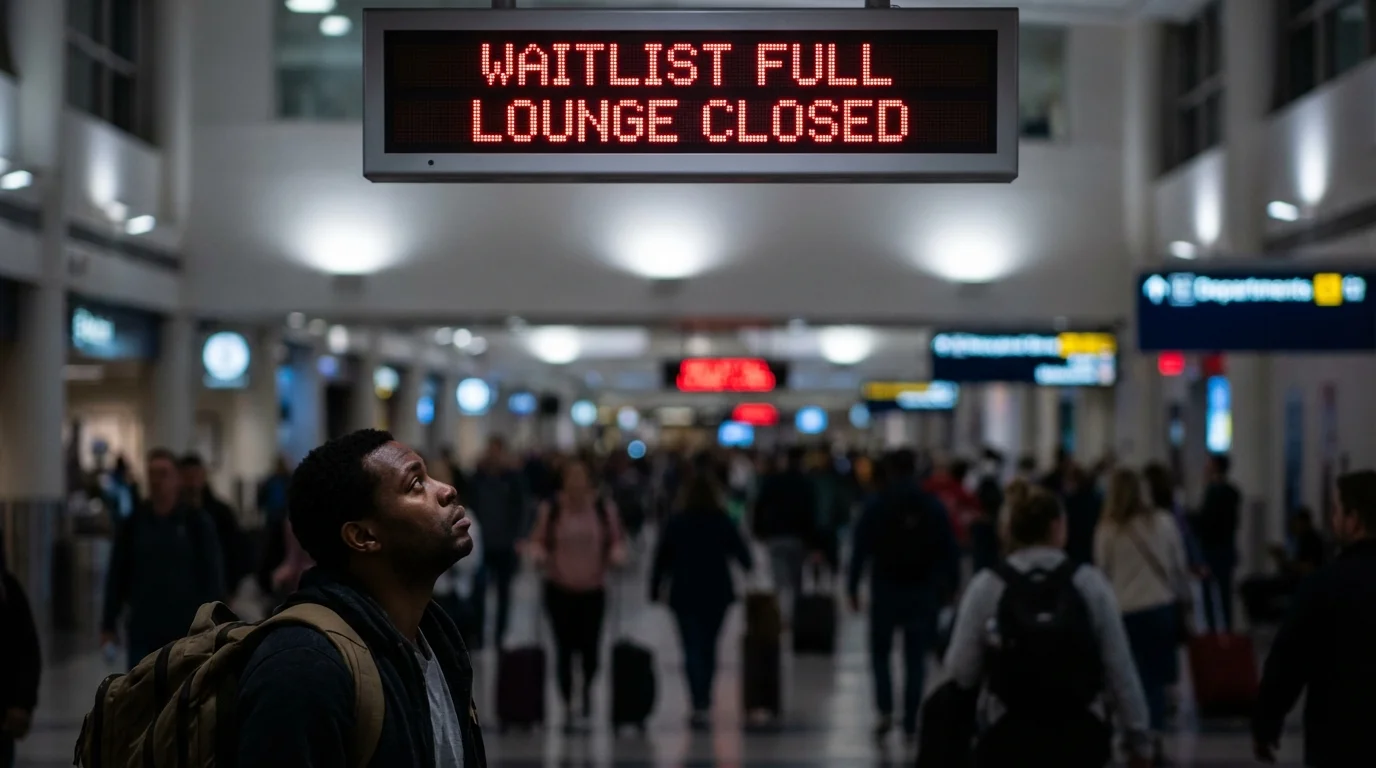
⚠️ Traveler Warning: The “Waitlist” Reality
I was rejected already several times because the lounge was overcrowded. Then they prioritize business class passengers over Priority Pass.
Pro Tip: Always open the Priority Pass app before you get to the airport. If the lounge accepts pre-bookings and you really need a shower or a desk, pay the $6 fee. It’s an annoyance, but it’s cheaper than missing out entirely.
Where the Value Still Exists
Despite the cuts, I still keep my membership active. Why? Because when it works, the value proposition is unbeatable. The network still covers over 1,300 lounges, and two specific areas have actually improved.
1. Plaza Premium Integration
For a brief dark period, Plaza Premium (a high-quality independent lounge operator) left the network. They are now back. This is huge for international travel. Lounges like the Plaza Premium at London Heathrow T2 or Singapore Changi T1 are significantly better than the average “The Club” lounge in the US.
2. “Be Relax” Spas and Sleep Pods
While restaurants are gone for most, “Experiences” often remain. In the US, this frequently includes Minute Suites (1 hour free) and Be Relax Spas (free massage or facial). I often find the Minute Suites more valuable than a crowded lounge if I just need to take a Zoom call in silence.
Best Cards for Priority Pass in 2025
If you are going to get Priority Pass, get it the right way. Do not pay cash.
- Capital One Venture X: The current champion. Lowest effective annual fee, allows unlimited guests (until the policy updates later in 2025/26), and grants access to Plaza Premium. Check our full Venture X review.
- Chase Sapphire Reserve: Still a solid card for transfer partners, but the loss of restaurants stings. The main upside is access to the new “Chase Sapphire Lounges” (which are excellent) using the Priority Pass card.
- Amex Platinum: The “Classic” choice, but harder to justify purely for Priority Pass due to the $695 annual fee. However, it adds Centurion Lounge access, which is a superior network.
For a deeper dive into the specific guest policies of these cards, you can check the official Priority Pass Conditions of Use.
Step-by-Step: How to Maximize Value
To ensure you actually get value from this program in 2025, follow this exact workflow for every trip:
- Check the App 24 Hours Prior: Do not just show up. Search your terminal in the app to see operating hours. Some lounges close to Priority Pass members at 2 PM to save space for airline business class passengers.
- Look for Alternatives: If the main lounge has bad reviews for overcrowding, look for a “Be Relax” spa or “Minute Suite” in the same terminal. These are often overlooked.
- Register for the Digital Card: Never rely on the physical card. It takes weeks to arrive. The digital QR code in the app updates instantly and is accepted at 99% of locations.
- Screenshot Your QR Code: Airport Wi-Fi is notoriously flaky just when you need it.
Conclusion: Is It Worth It?
Yes, but only as a free add-on.
Priority Pass in 2025 is no longer a luxury product; it is a volume product. It is a “better than nothing” insurance policy against a chaotic terminal. It will save you $15 on a bottle of water and a salad, and it might get you a shower in Dubai.
If you travel internationally at least twice a year, holding a credit card that offers this benefit is a mathematical no-brainer. Just lower your expectations, pre-book when possible, and never, ever pay full retail price for the membership.
Frequently Asked Questions (FAQ)
Can I still eat at airport restaurants with Priority Pass in 2025?
For most members, no. If your membership comes from a Chase Sapphire Reserve, Amex Platinum, or Capital One Venture X, restaurant credits are not included. You only get access to lounges and some spas/sleep pods. Only very specific legacy cards (like Citi Prestige) or non-US issued cards still retain this benefit.
How much does it cost to bring a guest into a Priority Pass lounge?
If you buy a membership directly, guests cost $35 per visit. However, most premium credit cards (like the Venture X or Chase Sapphire Reserve) allow you to bring two guests for free. Always check your specific credit card’s benefit terms, as this varies by bank.
Do I need the physical Priority Pass card to enter?
In 99% of cases, no. You can use the Digital Membership Card inside the Priority Pass app. However, a few select lounges (often in regions with older card readers) may still request the physical card, so it is wise to carry it as a backup for international trips.
What is the difference between Priority Pass Select and Standard?
“Priority Pass Select” is the wholesale membership given to credit card holders. It usually includes unlimited visits. “Standard” is the retail membership you buy, which requires you to pay a fee for every single visit. “Select” is almost always the better value.