

Most travelers treat airline alliances like a participation trophy. They fly United, they credit to United, and they take whatever crumbs of status they get. This is inefficient.
To a travel hacker, Star Alliance is not a club; it is a software system waiting to be optimized. As the world’s largest airline coalition, it offers a massive arbitrage opportunity: you can fly one airline (like United) but credit your miles to another (like Turkish Airlines) to earn status twice as fast for half the money.
In 2025, the landscape has shifted. SAS is gone, ITA Airways is on the horizon, and program devaluations are rampant. This guide cuts through the marketing fluff to explain exactly how the alliance works, why “Silver” status is mathematically worthless, and how to engineer your way to Gold.
The Network: Members & Structure (2025 Update)
Star Alliance consists of 25 full member airlines and “Connecting Partners.” The key to maximizing value is understanding that your benefits apply across the entire network, not just the airline you hold status with.
Major Recent Changes:
- SAS (Scandinavian Airlines): LEFT the alliance on August 31, 2024. Star Alliance benefits no longer apply.
- Asiana Airlines: Merger with Korean Air (SkyTeam) was finalized in Dec 2024. The brand is expected to retire in late 2026. Critical: Do not credit miles to Asiana Club; the program will close soon.
- ITA Airways: Left SkyTeam in early 2025 and is integrating into Star Alliance (Target: Early 2026).
| Region | Key Member Airlines | Primary Hubs |
|---|---|---|
| Americas | United, Air Canada, Avianca, Copa Airlines | Newark (EWR), Toronto (YYZ), Bogota (BOG), Panama City (PTY) |
| Europe | Lufthansa, SWISS, Austrian, Turkish Airlines, TAP Air Portugal, LOT, Brussels, Aegean, Croatia Airlines, ITA Airways (Joining 2026) | Frankfurt (FRA), Zurich (ZRH), Istanbul (IST), Lisbon (LIS), Rome (FCO) |
| Asia/Pacific | ANA, Singapore Airlines, EVA Air, Thai Airways, Air China, Shenzhen Airlines, Air India, Air New Zealand | Tokyo (HND/NRT), Singapore (SIN), Taipei (TPE), Bangkok (BKK) |
| Africa | Ethiopian Airlines, EgyptAir, South African Airways | Addis Ababa (ADD), Cairo (CAI), Johannesburg (JNB) |
Note on Connecting Partners: Juneyao Airlines is a “Connecting Partner.” This means you only get benefits if your itinerary connects to a full Star Alliance member flight. It is not a full member.
Status Tiers: The “Silver” Trap vs. The “Gold” Standard
Star Alliance has two status tiers: Silver and Gold. These map to your specific airline’s elite levels (e.g., United Premier Gold = Star Alliance Gold).
Star Alliance Silver: The Participation Trophy
I will be blunt: Silver status is virtually worthless. It offers two “benefits”:
- Priority Reservations Waitlist (Rarely clears in 2025).
- Priority Airport Standby (Bottom of the priority list).
If a credit card or airline program promises you “Star Alliance Silver,” assign it a value of $0 in your mental accounting. It saves you neither time nor money.
Star Alliance Gold: The Holy Grail
Gold is where the operational efficiency kicks in. It turns economy travel into a business-class ground experience. If you fly internationally 4+ times a year, this status is worth thousands of dollars.
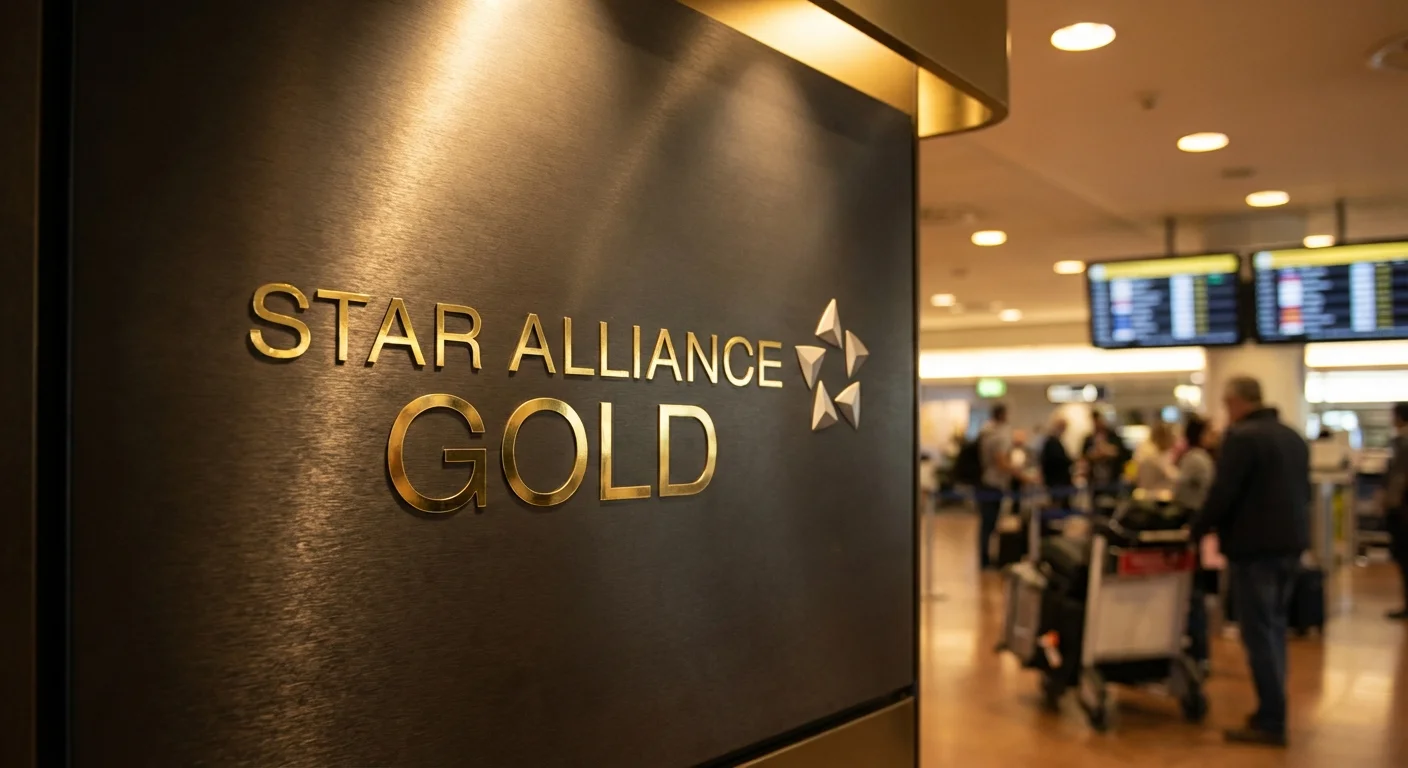
Deep Dive: Star Alliance Gold Benefits
Let’s break down the mathematical value of Gold status. I base these valuations on a traveler taking 10 round-trip international flights per year in Economy class.
1. Lounge Access (Valuation: $1,000+)
Gold members get access to over 1,000 Star Alliance Gold lounges globally, regardless of class of service. You can also bring one guest.
The Math: Even if you value a lounge visit conservatively at $50 (food, alcohol, Wi-Fi, quiet), 20 visits per year (10 round trips) equals $1,000 in value.
Note: United Gold members do not get United Club access on domestic US itineraries, but they do get access to partner lounges (like Lufthansa) when flying domestically.
2. Gold Track Security (Valuation: $300)
Time is money. Gold Track allows you to use the “Fast Lane” at security in major hubs like Heathrow, Frankfurt, and Istanbul. In my experience, this saves ~20 minutes per departure.
3. Extra Baggage Allowance (Valuation: $600+)
Gold members get an additional 20kg (44 lbs) or one extra piece of luggage. This is hard cash savings.
The Math: A checked bag on a transatlantic flight costs roughly $60-$75. If you use this benefit on just 4 round trips (8 segments), you have saved $480 to $600.
Strategic Status Acquisition: The “Shortcuts”
Most novices try to earn status on their home airline (e.g., United or Air Canada). This is often the hardest path because these revenue-based programs require high spending ($8,000+ USD). Instead, credit your flights to these programs to earn Gold faster.
1. The “Euro-Runner”: Aegean Airlines Miles+Bonus
Historically the easiest program, but major changes have been announced. Until November 5, 2026, the classic rules apply: 24,000 Tier Miles + 4 flights on Aegean/Olympic Air (after reaching Silver).
- Why it works: If you plan a summer vacation in Greece, you can knock out the 4 flight segments quickly.
- Caution: After Nov 5, 2026, retention requirements jump to 12 flights. If you cannot commit to visiting Greece annually, consider Turkish Airlines instead.
2. The “Long-Haul Value”: Turkish Airlines Miles&Smiles
This is my top pick for 2025 for travelers who don’t fly to Greece.
- Requirement: 40,000 Status Miles in a rolling 12-month period.
- Retention: Requalifying is easier—only 25,000 miles in the first year or 37,500 over two years.
- Sweet Spot: Turkish often counts “Fare Class” generously. A deep-discount economy ticket might earn 50-100% miles, whereas United might give you almost nothing based on spend.
3. The “Americas Shortcut”: Avianca LifeMiles
While known for selling miles, their status program is attainable.
- Requirement: 24,000 Qualifying Miles.
- The Catch: 12,000 of those miles must be on Avianca metal. This is great if you travel to Latin America, but useless if you stay in North America/Europe.
⚠️ Efficiency Warning: The Asiana Trap
You may read old guides suggesting Asiana Club as the easiest path (40k miles over 24 months). IGNORE THEM. Asiana’s merger with Korean Air was finalized in late 2024. Your status might not survive the transition to SkyTeam in 2026/2027, and your hard-earned miles could be converted at a devaluation. Do not invest in a dying currency.
Redemption Sweet Spots: Where the Value Is
Earning points is only half the battle. Redeeming them is where you realize the value. You should almost never use “Pay with Points” options. You must use the Award Charts.
1. Air Canada Aeroplan: The King of Flexibility
Aeroplan is currently the best designed frequent flyer program in the alliance.
- No Fuel Surcharges: You won’t pay the $800+ fees Lufthansa charges on other partners.
- Stopovers: For just 5,000 extra points, you can add a stopover on a one-way ticket. Example: Fly New York to Frankfurt (Stop for 3 days) -> Frankfurt to Cairo.
- Family Pooling: You can combine points with up to 8 family members.
2. United MileagePlus: The “Excursionist Perk”
While United’s redemption rates are dynamic, their Excursionist Perk remains a high-value anomaly.
The Math: If you book a multi-city round trip (e.g., US to Europe), you get a free one-way flight within that region.
Example: Chicago -> London (Paid) / London -> Munich (0 Miles) / Munich -> Chicago (Paid).
3. Avianca LifeMiles: The Mixed-Cabin Hack
LifeMiles is glitchy, customer service is nonexistent, but the math is undeniable. They do not pass on fuel surcharges.
Frequently Asked Questions
Does Star Alliance Gold get me into United Polaris lounges?
No. United Polaris lounges are exclusively for passengers flying long-haul Business or First class, regardless of status. However, as a Star Alliance Gold member, you can access United Club lounges on international itineraries, or partner lounges (like Lufthansa Senator Lounges) even when flying Economy.
Can I status match from Delta or American to Star Alliance?
Direct alliance matches don’t exist, but individual airlines often run “Status Challenges.” United and Air Canada frequently offer challenges where you get temporary status for 90 days and must fly a certain amount to keep it. Turkish Airlines occasionally runs a direct status match if you send them proof of your current status and a passport scan.
What happened to the ANA Round-the-World ticket?
ANA discontinued the issuance of new Star Alliance Round-the-World (RTW) awards on June 23, 2025. You can no longer book these high-value itineraries. For multi-stop trips, look at Air Canada Aeroplan’s stopover rules instead.
Is Star Alliance better than SkyTeam or Oneworld?
For global coverage, yes. Star Alliance has 25 members compared to SkyTeam’s ~19 and Oneworld’s ~13. If you need deep connectivity in Europe (Lufthansa Group) and Asia (ANA, Singapore, Thai), Star Alliance is superior. However, for sheer redemption value, Oneworld (via Qatar/Cathay) often has better business class products.